

I frequently tell anyone who will listen that legal research and medical record analysis are two of the most powerful use cases for generative A.I. as applied to the practice of law. And I say that because I have seen it with my own eyes. When I had the opportunity to sit down with the Paxton team for a full demo, something became very clear within the first minute: this is not another generic chatbot that put on a tie to look legal. Paxton was built from the ground up to understand how a law firm actually operates: the case files, the deadlines, the medical chronologies, the demand letters. If you handle personal injury cases and you are still building medical chronologies by hand, page by page, this is exactly what you need to read today.
Favorite law firm use cases: Automatic generation of complete medical chronologies in minutes for personal injury cases; demand letter drafting with clinical and legal context already integrated; federal and state case law research with instantly validated citations.
Features & Functionality
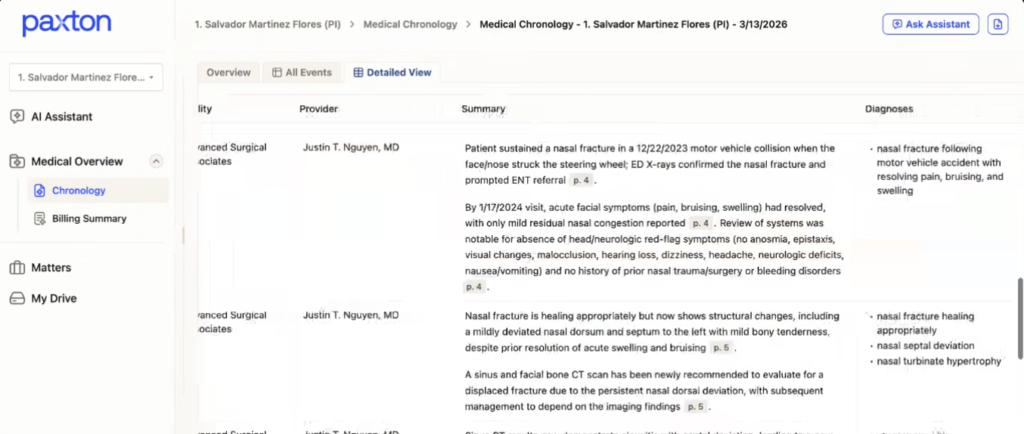
Everything in Paxton starts with a matter folder where everything is centralized: documents, analysis, conversations with the assistant, chronologies, and billing records. From the moment you create the matter and upload medical records, the platform gets to work. It extracts clinical events, organizes them chronologically, and delivers a detailed table with date of service, provider, diagnosis, ICD-10 code, procedures, and the exact source file where each piece of data came from. But here is the part that caught my attention the most: every entry has a validation button that takes you directly to the original document with the relevant excerpt highlighted. As you can see in the image, the Salvador Martinez Flores case shows exactly that: each medical visit with its provider, clinical summary, and diagnosis, with page numbers linked back to the original record. No black boxes. Paxton gives you the source so you can verify it yourself.
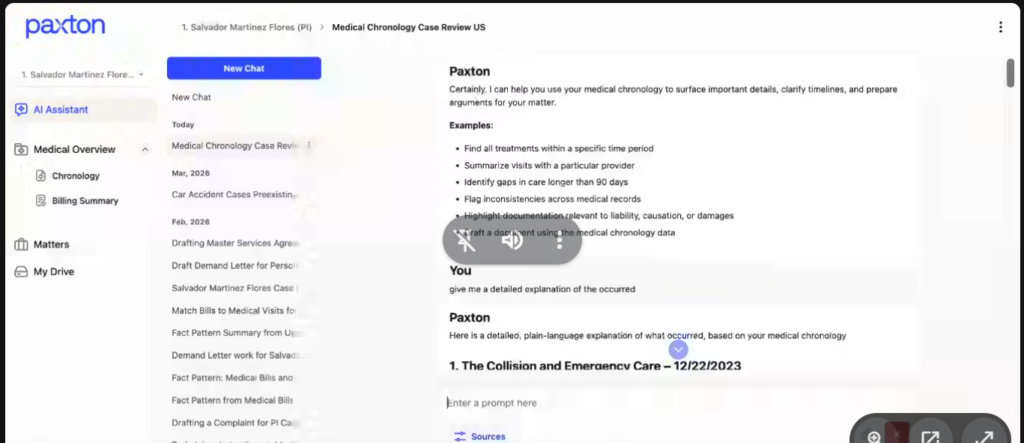
The same workflow applies to medical billing information, and this is where personal injury attorneys really start to see the value. Once you upload the case bills, Paxton generates a summary of up to hundreds of entries organized by date, charge type, procedure code, and amount, all with traceability back to the source document. And once you have all that information inside the matter, the A.I. Assistant steps in in a way I honestly did not expect. As shown in the image, the assistant does not just wait for instructions: it proactively suggests examples of what you can ask it, from identifying gaps in medical care to preparing causation arguments. You interact with it in plain language, and it already knows which case you are talking about because the full chronology is active as context.
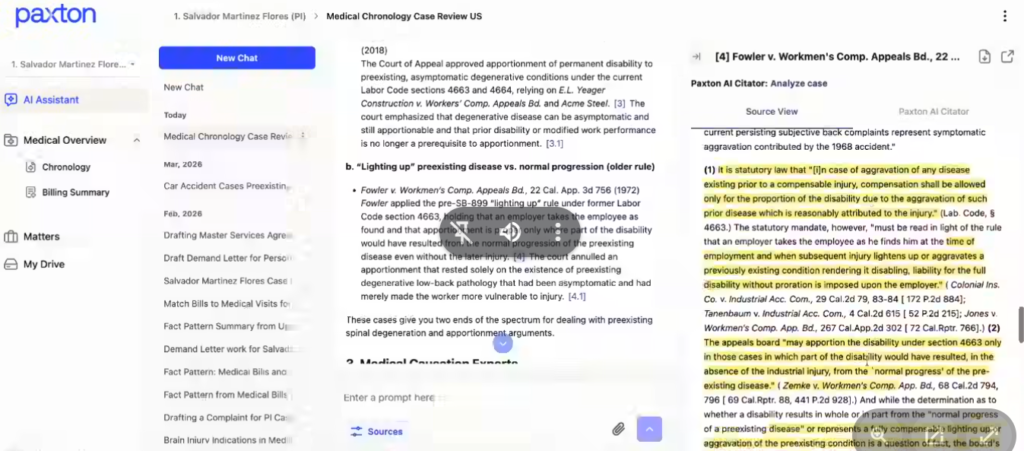
Now, what happens when you need legal research? This is where Paxton truly separates itself from other tools. You can ask it for cases related to a specific jurisdiction, say California with federal coverage, and it delivers relevant case law with validated citations, each one linked to its source. And it is not an exercise in blind trust: the image shows exactly this in action. The case Fowler v. Workmen’s Comp. Appeals Bd. appears cited in the analysis, and on the right side the platform opens the source document with the exact paragraph highlighted in yellow. On top of that, the A.I. Citator automatically evaluates whether that precedent is still good law. No hallucinations. No invented citations. That is not a minor detail for our profession.
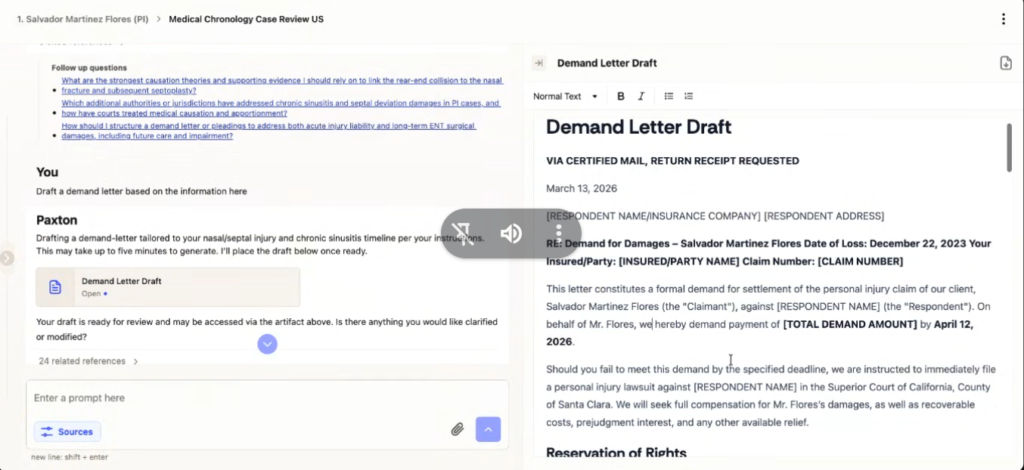
And then we get to the part that honestly left me floored: the drafting. With a single prompt, Paxton generates a complete demand letter based on all the medical, clinical, and legal information it already has in context inside the matter. The image says it all: on the left, the chat where the document is requested; on the right, the demand letter already fully structured, with a formal header, date, reference to the Salvador Martinez Flores case, total demand amount, and reservation of rights, ready to edit within the platform or download as a Word file. And if your firm has its own template that reflects the partners’ writing style, you can upload it and Paxton adopts it as the base. This is not a generic first draft: it is a document built on the actual facts of the case.
Pricing & Plans
Paxton offers two paths. The first is self-serve: you can go directly to their website and buy a monthly subscription at $499 per user per month, or an annual subscription at $250 per user per month, a 50% savings. The second path is Enterprise, ideal for firms with three or more employees, with custom pricing based on case volume and dedicated onboarding to make sure partners, paralegals, and staff actually adopt the tool. And here is the key ROI point: users report up to 80 hours of recovered time per month. Do the math with your hourly rate and tell me if $250 per month does not pay for itself within the first few days. For those who want to try before committing, Paxton offers a 7-day free trial. It is worth it.
What Makes It A.I. Enabled?
Paxton is built on a proprietary large language model (LLM) trained exclusively on legal materials: cases, statutes, regulations, and legal documents. That specialization is not cosmetic, it translates into real results. The platform achieves a 94% non-hallucination rate on the Stanford Legal Hallucination Benchmark, a standard that for our profession is non-negotiable. The use of natural language processing (NLP) allows any attorney to interact with the platform in plain English without needing technical prompts, while the A.I. Citator automatically evaluates whether cited precedents remain valid law. The result is a tool that amplifies your judgment as an attorney without pretending to replace it.
Security & Privacy
I know what you are thinking: “Great, but my client documents are confidential.” And that is exactly the right question. Paxton complies with SOC 2, ISO 27001, and HIPAA standards, with advanced encryption for data both in transit and at rest, and access controls based on the principle of least privilege with quarterly reviews. And the question that matters most in our industry: data you upload to the platform is never used to train A.I. models and remains completely private. For firms handling sensitive medical records in personal injury cases, that is not a minor technical detail: it is the difference between a tool you can use with professional confidence and one you cannot.
The Judgment
If you handle personal injury cases and you are still building medical chronologies by hand, researching case law on platforms that cost three times as much, or starting demand letters from scratch every single time, Paxton deserves a shot. Not because I say so, but because the product speaks for itself. In a market full of A.I. tools that promise a lot and deliver little, Paxton has something most do not: full transparency on its sources and a workflow that fits naturally into what attorneys already do every day. At $250 per user per month with annual billing, the cost of not trying it is, in many cases, greater than the cost of doing so. Start with the 7-day free trial, no contracts, no interviews, no negotiations, and let the work speak for itself.
Have Feedback?
I’ve reserved a special space each week for you to vent, supplement with relevant info, or ask questions about the product. The only way the content gets better is if you participate. I look forward to hearing from you! You can e-mail me here.