After years of working closely with law firms on their operations, there’s one conversation that comes up time and again: attorneys are buried in first-pass document review. Settlement agreements, service contracts, NDAs, retainer agreements, due diligence packages. Each document demands careful reading, identification of problematic clauses, risk flagging, and proposed revisions—work that genuinely requires legal judgment. But the sheer volume creates a familiar bottleneck. Matters get turned away or delayed, associates burn out on mechanical review at hour eleven, and the clauses that matter most are the easiest to miss when fatigue sets in. That was exactly the reason I decided to evaluate Vaquill A.I. in depth—not as another conversational assistant, but as a tool capable of performing real document auditing with the depth and precision an experienced attorney would expect. What I found was not another A.I. product making vague promises, but a platform that executes substantive legal work directly on the firm’s own documents, with a level of organization and rigor that lets attorneys take on more matters, strengthen the defensibility of their review, and redirect their judgment toward the strategy and client relationships that command premium rates.
Favorite law firm use cases: Line-by-line auditing of settlement agreements, commercial contracts, and NDAs to identify ambiguities, one-sided clauses, and protection gaps; comparison of multiple contracts of the same type in matrix format with textual citations per cell; automatic construction of timelines from pleadings, deposition summaries, and matter communications.
Features & Functionality
What sets Vaquill A.I. apart is that it does not operate as a generic legal chatbot. The platform works directly on the documents the attorney uploads and delivers substantive analysis anchored in the text of the document itself, with verifiable citations you can confirm by opening the original file. That transforms the experience of document review, because it converts hours of work into a structured analysis completed in minutes, without sacrificing depth.
To evaluate this capability under real conditions, I uploaded a twelve-page sample settlement agreement, a hypothetical personal injury matter between Jane Doe and Acme Logistics, intentionally drafted with problematic clauses to see how far the tool would go. I gave Vaquill A.I. a single instruction: perform a line-by-line audit identifying ambiguous language, unenforceable provisions, one-sided clauses, missing protections, and internal contradictions, quoting the exact text of the document for each finding.
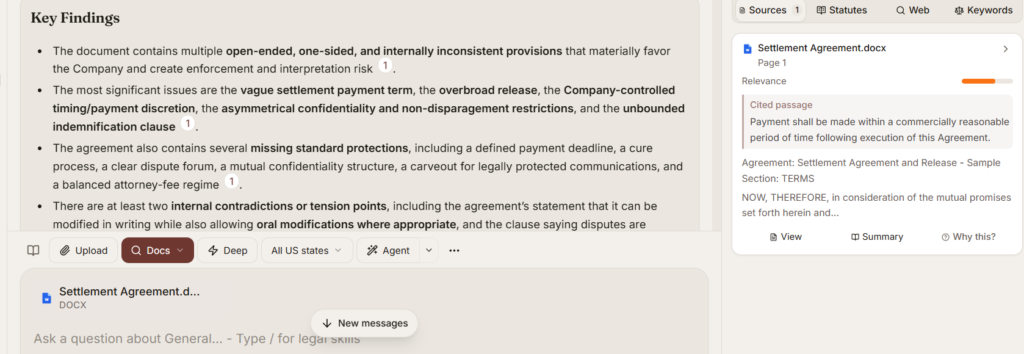
In less than a minute, Vaquill A.I. returned a structured analysis that identified more than twenty specific issues in the contract, organized into five clear categories: ambiguous language, potentially unenforceable provisions, one-sided clauses against the Claimant, missing standard protections, and internal contradictions between sections. Each finding included the exact textual citation from the document, an explanation of the associated legal risk, and in many cases specific suggestions on how to strengthen the language. But the real differentiator appeared in what came next.
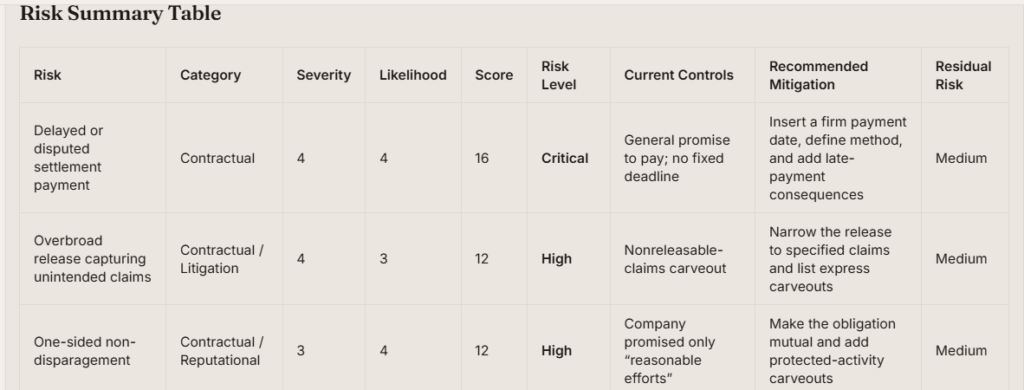
Vaquill A.I. did not stop at diagnosing problems. It built a risk summary table that quantified each finding with severity scores, likelihood scores, and categorized risk levels, clearly identifying which clauses represented critical exposure versus which were minor adjustments. That prioritization capacity is precisely what separates a functional tool from one that actually accelerates decision-making.
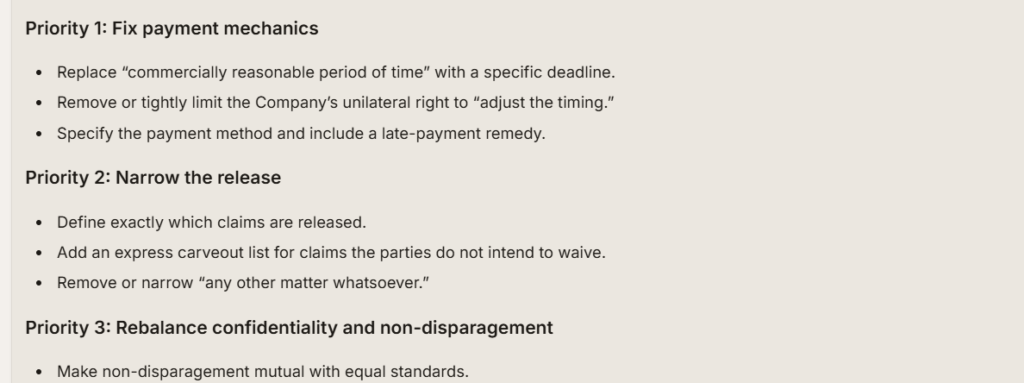
After the risk matrix, the platform delivered a prioritized mitigation roadmap that ordered corrections by strategic importance for the Claimant, starting with the clauses of greatest exposure and descending toward incremental adjustments. It is exactly the kind of output a partner would want to review before sending the contract back to opposing counsel with redlines.
Beyond single-document analysis, Vaquill A.I. includes the Document Matrix function, which allows reviewing hundreds of contracts in spreadsheet format where rows are documents and columns are the questions you want answered. Each cell is anchored to a textual citation from the source document, making comparison between contract versions, NDAs, or agreements something that can be done in minutes instead of hours. For firms handling due diligence or portfolios of similar contracts, this function alone justifies exploring the product.
The platform also integrates directly within Microsoft Word, Outlook, and Google Docs, allowing attorneys to draft, redline, and validate text without leaving the environment where most legal work already takes place. Redlines export as native DOCX files with real Track Changes, indistinguishable from a Litera or Draftable output, which means opposing counsel has no way of knowing that the redline was built by an A.I. tool. Vaquill A.I. also constructs automatic timelines from all documents in a matter, and offers a dedicated email address per matter that allows forwarding a document and receiving back a cited response within the same thread.
For legal teams, the platform incorporates matter-level controls, Slack-style thread branching for exploring different arguments without losing the main research line, voice notes with automatic transcription, and native bots for WhatsApp, Slack, Zoho CRM, and Google Drive, plus API and MCP access for Microsoft Teams, Telegram, Claude, Cursor, Discord, and VS Code. The entire flow is designed to fit within how a modern firm actually operates, without forcing attorneys to change the way they already work.
Pricing & Plans
Vaquill A.I. operates on a simple and straightforward pricing model, with no tiers or features locked behind premium plans. The Vaquill Professional plan costs $99 USD per user per month, with per-seat scaling and no rigid commitments. A solo attorney pays $99, an in-house team of three pays $297, a firm of five pays $495. On annual billing, the price drops to $990 USD per user per year, which equals two months free (17% savings). All features are included from the first seat, and the firm can add or remove seats at any time. They also offer a 7-day free trial with full access, no credit card required. For firms with special security requirements, VPC or on-premises deployment, white-label needs, training on the firm’s internal corpus, or volume contracts for 50 or more seats, there is an Enterprise plan with custom pricing, single-tenant infrastructure, 99.95% SLA, and a dedicated customer success manager.
What Makes It A.I. Enabled?
Vaquill A.I. is built on a combination of natural language processing, semantic search, and large language models specifically applied to the legal domain. What distinguishes its architecture is that it does not limit itself to generating text, but operates as an agentic system capable of reasoning through multiple steps, remembering the context of matters through a persistent Memory layer, and learning the firm’s preferences through teachable Skills. When an attorney uploads a document and requests an analysis, Vaquill A.I. does not produce a surface-level summary. It extracts specific clauses, identifies problematic patterns, connects each finding to the original text, and delivers structured outputs such as risk matrices and prioritized roadmaps. That combination of agentic intelligence with deep document analysis is what allows Vaquill A.I. to function not as a legal chatbot, but as an assistant capable of executing substantive work with auditable precision.
Security & Privacy
For law firms, the security of client information is non-negotiable, and Vaquill A.I. has structured its platform considering exactly that standard. All information is handled with end-to-end encryption, uploaded documents are never used to train A.I. models, and attorney-client privilege is preserved as a design principle. The platform is aligned with SOC 2 and ISO 27001, ready for DPDP compliance, and offers role-based access controls (RBAC), single sign-on with SAML, and complete audit logs. For firms on the Enterprise plan, there are also options for private cloud, on-premises, or air-gapped deployment, dedicated single-tenant infrastructure, custom BAAs and DPAs, and configurable data residency in the US, EU, India, or Australia.
The Judgment
Vaquill A.I. is not just another legal search tool. It is a document analysis layer that operates over the firm’s files with the depth and rigor an experienced attorney would expect from a senior associate. For firms facing significant volumes of contract review, due diligence, or matter analysis, the value appears from the first document processed. The combination of line-by-line auditing with textual citations, Document Matrix over contract portfolios, native Word and Outlook integration, and a transparent pricing model with no locked features positions it as a serious option for firms of any size. The 7-day free trial with full access is probably the best way to evaluate its real impact. Upload a contract that would normally take an associate two hours to review, assign Vaquill A.I. the same work, and compare the outputs. That measurement alone will tell you more than any demonstration.
Have Feedback?
I’ve reserved a special space each week for you to vent, supplement with relevant info, or ask questions about the product. The only way the content gets better is if you participate. I look forward to hearing from you! You can e-mail me here.