

Think about the last matter you handled from the initial client meeting through filing in court. You explained the facts to your client, explained them again to your paralegal, then rebuilt the same context for your legal research tool and once more when it was time to start drafting. Somewhere along the way, you found an important admission buried in a deposition, made a mental note of it, and weeks later spent twenty minutes trying to find it again. None of that is legal work. It is keeping the case alive in your own memory because your software cannot. StrongSuit, which recently relaunched its platform as StrongSuit 2.0, was built to solve exactly that problem. You set up the matter once, and from that point forward the platform keeps that context available across every tool you use.
Favorite Law Firm Use Cases: Document review, deposition analysis, case timelines, legal research, and litigation drafting, all connected around the same matter.
Inside the Product
Everything in StrongSuit starts with the Matter Portal. Instead of opening a chat window and explaining your case from scratch, you begin by creating the matter. This is where you organize the parties, jurisdiction, and most importantly, the documents that make up the case file. That matter becomes the case’s memory and the foundation for everything else in the platform.
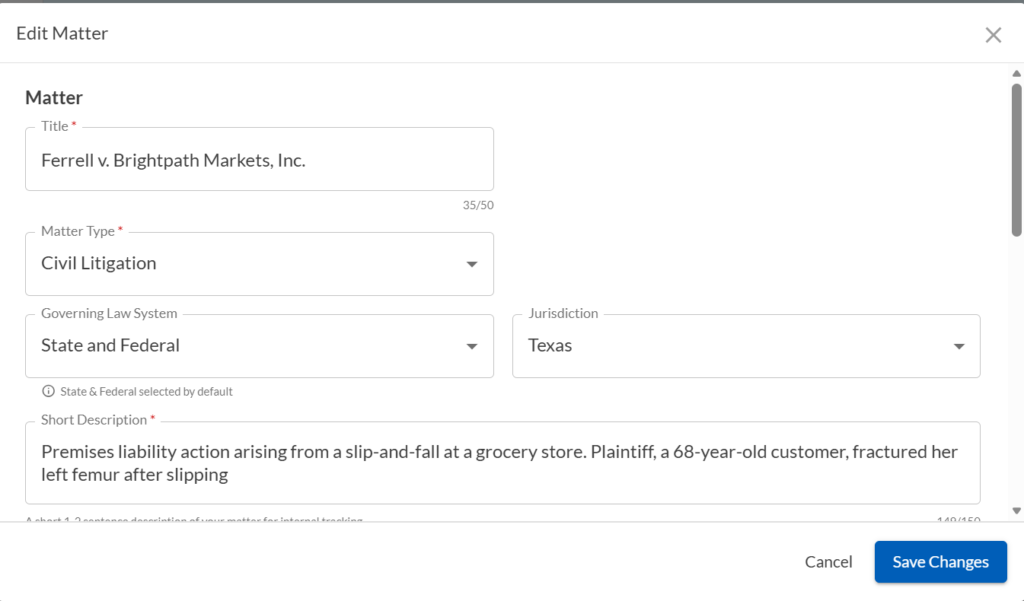
The next step is uploading the case file. Contracts, complaints, depositions, emails, and medical records are added once and become available for every task that follows. One design decision stands out immediately. As StrongSuit processes the matter, it automatically fills in portions of the case information, but every field remains visible, editable, and can be removed at any time. The platform is explicit that it does not invent facts about your case, which is exactly the kind of design choice lawyers want to see when working with sensitive documents.

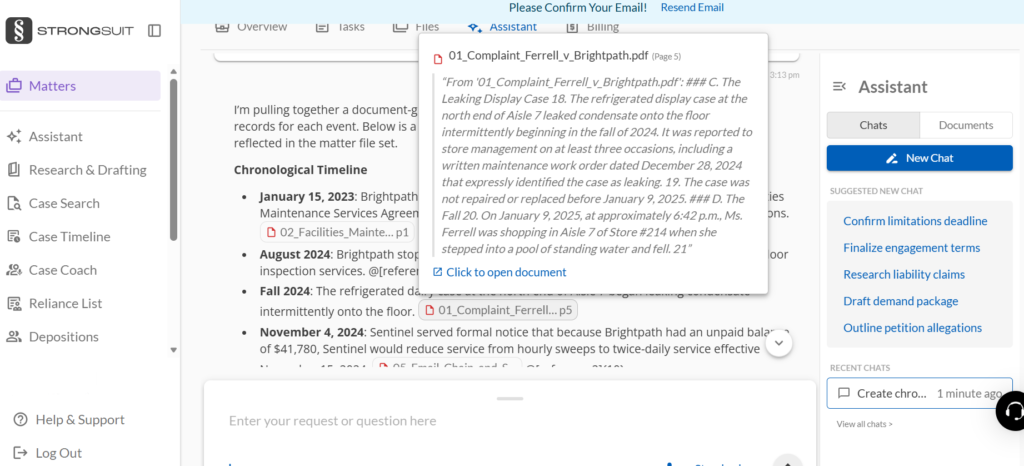
Once the Matter is built, the platform begins to show its value. To test it, we uploaded a fictional litigation file and asked the assistant to build a chronological timeline of the key events, citing the supporting document for each one. Within seconds, it reconstructed the entire story using contracts, emails, depositions, and medical records, pointing back to the source of every fact. It felt less like asking a chatbot a question and more like working with someone who had already read the entire case file.
With that same context already available, we then asked StrongSuit to draft a settlement demand letter using only the information contained in the matter. The result was a well-structured first draft that organized the facts, built the legal argument, and supported each section with references to the underlying documents. This is where StrongSuit’s approach really comes together. It understands the case first, then uses that understanding to produce legal work without forcing you to rebuild the context every time you start a new task.

After spending some time working inside the platform, you stop thinking about individual features like research, timelines, or drafting. What stays with you is the feeling that the case no longer depends on your memory. It lives inside the Matter, where every task builds on the same shared context. That difference may sound subtle on a feature list, but it becomes obvious once you start working on a real case.
Cost
StrongSuit’s Individual plan costs $249 per month and includes access to the full platform and its legal research database, with no long-term contracts or minimum license requirements. A free trial is also available, allowing attorneys to evaluate the platform using a real matter before making a decision. While it is priced above entry-level legal AI tools, it remains well below enterprise litigation platforms. That positioning is intentional. It gives solo attorneys and small firms access to advanced litigation capabilities without turning implementation into a project of its own.
Why It Works
The value of a matter-centered system is not simply that it saves time. It is that the context no longer depends on you. When your research tool does not know what your document review uncovered, and your draft does not know what your timeline established, the lawyer becomes the only connection between them. You end up carrying the case in your head and moving facts from one tool to another. StrongSuit’s approach is to let the software carry that burden so your attention stays where it creates the most value: legal judgment.
Privacy & Confidentiality
StrongSuit states that it does not use client information to train AI models or share documents with other users. The platform includes security measures such as encryption, SOC 2 certification, and an infrastructure designed to protect confidential information. There is, however, one important distinction. StrongSuit processes your information to generate each response and then discards it unless you choose to save it in your account history. That is different from a strict zero-retention model, and it is worth reviewing if your firm has specific policies governing the use of artificial intelligence.
Verdict
If your practice revolves around litigation and you currently rely on multiple tools that never seem to share the same context, StrongSuit deserves a serious look. Its greatest strength is not the number of features it offers, but the way it keeps your knowledge of the case connected throughout your entire workflow. The best way to evaluate it is also the simplest. Upload a real matter, add the case file, and ask a question that would normally require you to read hundreds of pages. If the answer comes back grounded in your own documents with the case context already built in, you will immediately understand what makes StrongSuit different.
Have Feedback?
I’ve reserved a special space each week for you to vent, supplement with relevant info, or ask questions about the product. The only way the content gets better is if you participate. I look forward to hearing from you! You can e-mail me here.