A new case arrives as one massive PDF: medical records, deposition transcripts, pleadings, payment histories, all mixed together. Before an attorney can do anything useful with it, someone has to separate, identify, name, and organize every document. But here’s the frustrating part: your firm has probably already processed hundreds of cases like this. It already knows what those documents look like, how they should be organized, and what information matters. That knowledge lives in your closed files and in the work your firm has already done. The question is: can your case management system remember it?
Favorite Law Firm Use Cases: organizing and filing new case materials, summarizing medical records and deposition transcripts, building a living case narrative, answering questions about the facts of a matter, and recommending time entries based on the firm’s billing history.
Inside the Product
Start at the front door: that 300 page PDF. You upload it to Automated Intake, and Caisey reads it, splits it into individual documents, and suggests a name and category for each one. But it doesn’t file anything on its own: every document goes into a review queue for a person to accept before it enters the case file. AI takes the first pass; human judgment gives the final approval.
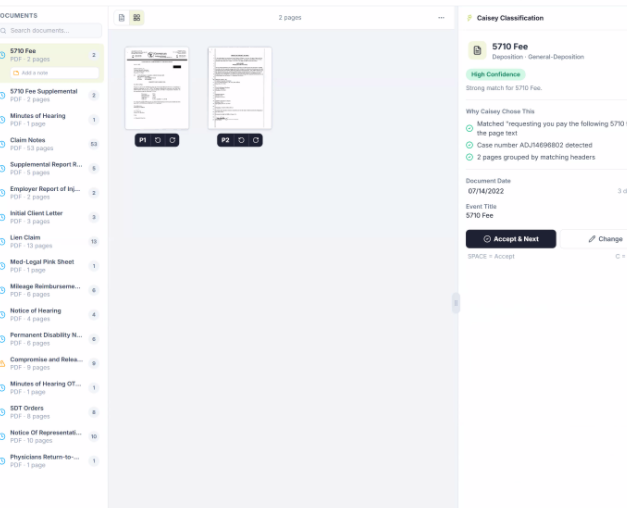
What’s interesting is how it learns to organize. With Document DNA, Caisey compares new documents with how your firm has classified similar documents in the past. Instead of imposing a generic structure, it learns from how your firm already works. That same knowledge is then used to summarize documents and build a living case narrative that updates as the case changes.
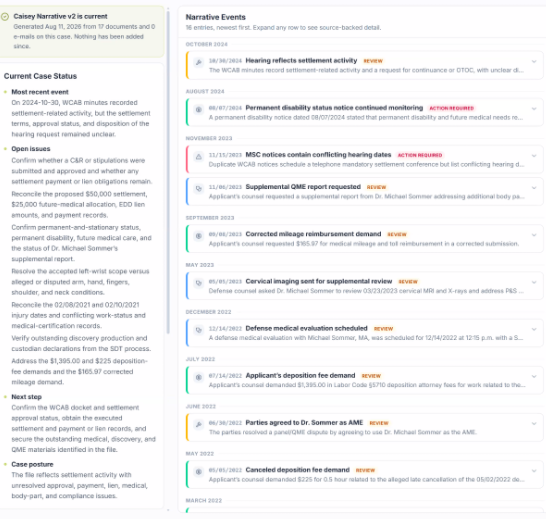
This is where the tool starts to feel genuinely useful to an attorney. You can open a new case and get an overview of the facts, a timeline linked to its source documents, and answers to questions in natural language, all based on the case file rather than the internet. And before that narrative leaves the firm, an attorney can review and approve it, creating a record of who approved it and when. AI speeds up the work, but accountability still has a name attached to it.
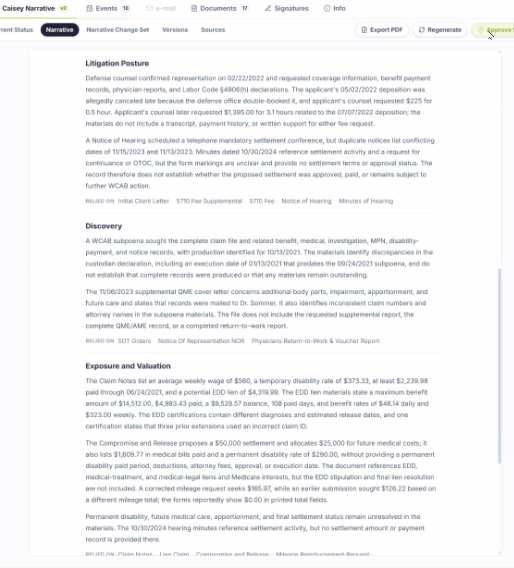
There’s another detail that could be especially interesting for defense firms: Caisey can recommend time entries based on what the firm’s clients have historically accepted or cut. The firm’s accumulated knowledge doesn’t have to stay buried in closed files; it can become a tool for working the next case. That’s the real differentiator with CaseFriend: it doesn’t start from scratch. It starts with everything your firm already knows.
Cost
CaseFriend does not publicly list its prices. The platform is offered as a monthly subscription, with Caisey included rather than charged as an additional add on. Mail Intake is also included. Firms need to request a demo to get a quote.
Why It Works
Most legal AI tools start with the documents you give them. CaseFriend starts with what your firm already knows. Caisey can draw on the firm’s history to classify documents, summarize information, and connect facts across files. That means each new case can benefit from the work the firm has already done.
And that changes the proposition: it’s not just about processing documents faster. It’s about turning the firm’s accumulated knowledge into intelligence that can be used again and again, while keeping the attorney at the center of review and approval.
Privacy & Confidentiality
CaseFriend states that firms’ documents remain within its platform and that client data is not used to train public or third party models or shared between firms. AI generated outputs also belong to the firm, and Caisey’s responses include an indication that they were generated by AI to facilitate review. For email and calendar integrations, access requires authorization and can be revoked. CaseFriend does not, however, publicly provide complete details about its hosting infrastructure, the AI model it uses, or security certifications such as SOC 2. For firms handling sensitive information, especially medical records, we recommend requesting security and privacy documentation directly before implementing the platform.
Verdict
If you run a workers’ compensation defense or liens practice, CaseFriend is worth a demo. It understands the kind of work these firms do and turns accumulated knowledge into something that can be used on every new case.
But the idea goes beyond CaseFriend: the next time a vendor shows you AI inside your case management software, ask whether it only reads the document in front of it or whether it can also learn from everything your firm has already done. Because the case may be new. The knowledge behind it isn’t.