
Reviewing a filing is not just about finding errors. It also means confirming that each statement complies with the applicable rules, that the information is supported by the client’s records, and that the conclusions can be traced back to their source. Now bear with me if you are not a securities attorney (but I usually give them so much less attention). but in a 10-K, for example, that means reviewing Reg S-K requirements, staff guidance, prior comment letters, and how comparable companies are handling the same disclosures. Finiti Legal starts with that problem and aims to make the review process more traceable, with the sources and reasoning behind each conclusion.
Favorite Law Firm Use Cases: Form reviews for 10-Ks, 10-Qs, 8-Ks, and 20-Fs; 10b-5-style verification against the data room; benchmarking disclosures against peer companies; and updating MD&A when new figures or client information come in.
Inside the Product
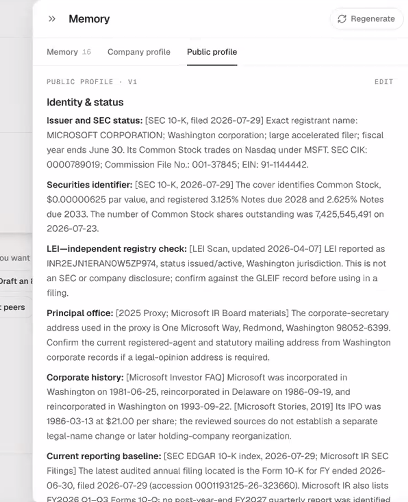
Finiti starts by building context. In the client workspace, you can upload prior filings, data room documents, precedents, and drafting or review preferences. The platform also builds a profile of the issuer and a universe of peer companies, while keeping track of the source for each piece of information so that context can be used throughout subsequent reviews.
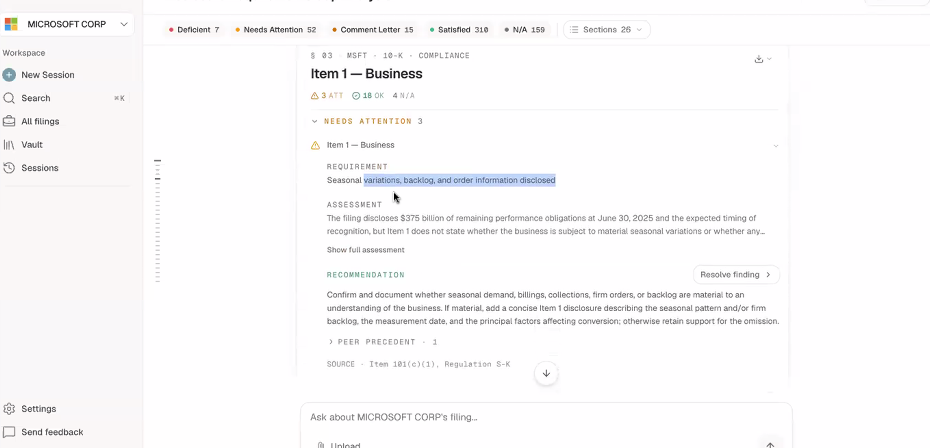
With that context in place, Finiti reviews a filing against applicable requirements, staff guidance, comment letters, and disclosures from peer companies. Findings are classified as deficient, needs attention, comment letter, satisfied, or not applicable. When you open a finding, the platform shows the requirement, what the filing currently says, the assessment, the recommendation, and the source supporting the analysis.
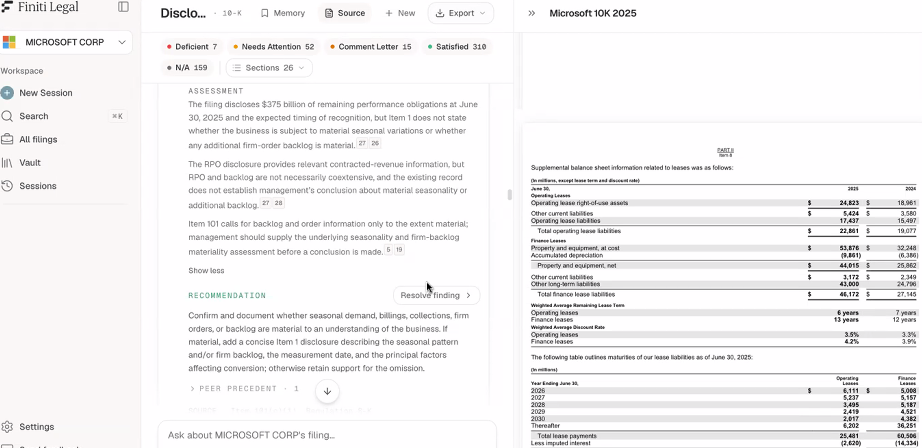
The split view lets you open the source document directly and review the text on which the finding was based.
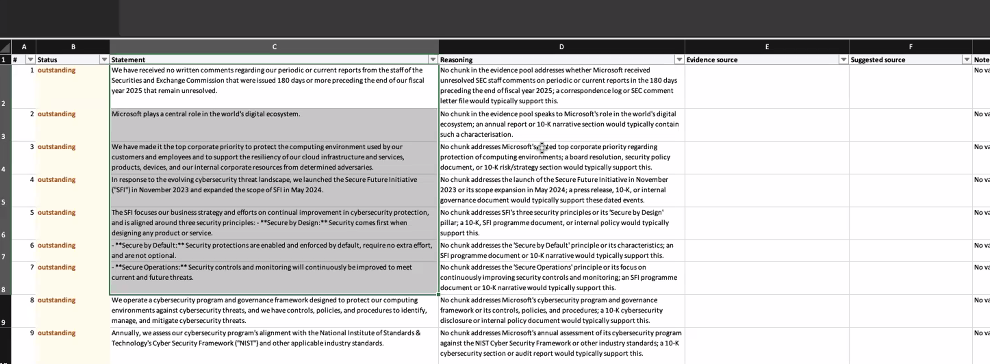
The second workflow verifies factual statements in a draft against the documents available in the Vault. You define the scope and sources, and Finiti returns a table connecting each statement to its supporting evidence, citation, and reasoning. When it cannot find sufficient support, it generates an outstanding information list that can be turned directly into a request for the client.
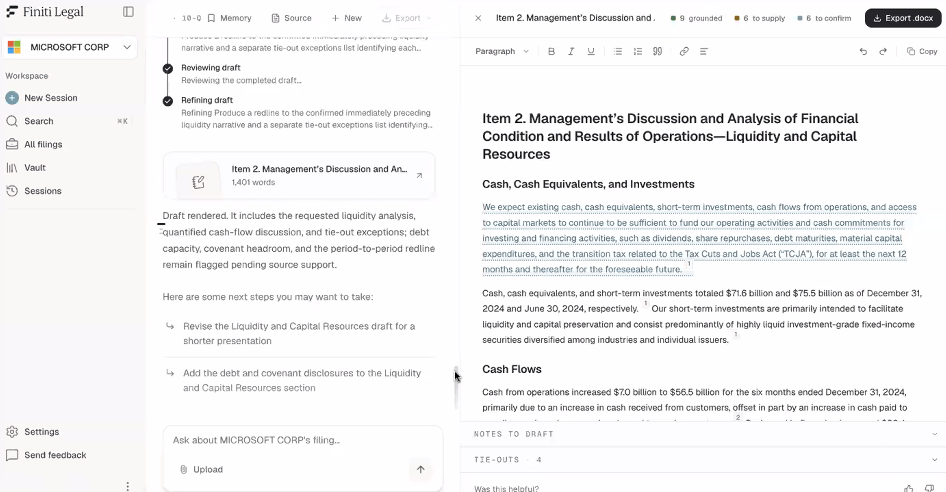
Finiti can also help update your filings when new figures come in, showing which parts are supported, which need additional information, and which require confirmation. The same environment can be used to work on risk factors and benchmark disclosures against peer companies.
Cost
Finiti does not publish pricing or per-user plans. Instead, the platform is designed for companies across different sizes and levels of regulatory exposure, from micro-cap and small-cap to mid-cap and large-cap or dual-listed companies. The site also offers a disclosure risk assessment and the option to request a demo, but does not list a standard price. For a law firm or company evaluating Finiti, that means pricing will need to be determined directly with the sales team based on the company’s profile, scope of use, and team requirements.
Why It Works
Many legal AI tools are primarily designed to generate or transform text. Finiti takes a different approach: each output points back to something verifiable, whether that is a regulatory provision or a document in the client’s files, and the product is designed to produce deliverables, not just answers. A compliance report with a source appendix. A verification table with citations. An outstanding information list that can be sent to the client. In a practice where the review process matters as much as the final document, that traceability is an important difference. It is not just about helping you write, but about showing where each conclusion came from.
Privacy & Confidentiality
Data security is especially important for a platform that works with filings, financial information, and internal client documents. Finiti describes an architecture designed to protect that information, with encrypted storage, access controls, and measures intended to prevent client data from being used to train the underlying models. It also states that its SOC 2 Type II certification is in the process of being completed. For a firm evaluating the platform, that point deserves attention: a certification in progress is not the same as a completed certification. Before bringing Finiti into a live matter, it is worth confirming directly with the company the current status of its controls, where data is stored, how it is handled and retained, and what options are available for access and privacy management.
Verdict
Finiti is primarily designed for capital markets teams and the public companies they advise, particularly where the work involves reviewing filings, verifying information against the data room, and documenting where conclusions come from. For that type of practice, its proposition is interesting because it does more than generate text: it connects findings to their sources and turns the review into deliverables that can be consulted and verified later. And that approach points to an idea that goes beyond Finiti: in legal AI, the value is not only in producing something faster, but in being able to understand and trace how the result was reached.
Have Feedback?
I’ve reserved a special space each week for you to vent, supplement with relevant info, or ask questions about the product. The only way the content gets better is if you participate. I look forward to hearing from you! You can e-mail me here.