
You are three paragraphs into a demand letter and write a sentence you know is true. The treating physician documented the shoulder complaint at the first visit, not three months later as the adjuster keeps implying. You know because you read it, but now you need to find the page to prove it.
That trip back into the file is something nobody bills for and everyone does. It is not research or analysis. It is fact chaos: the cost of keeping the facts of a case in your head instead of having them organized, traceable, and verifiable. Mary Technology built its product around that problem.
Favorite Law Firm Use Cases: Building timelines from medical and clinical records, tracing every fact in a draft back to its source document, reviewing bank statements, and identifying gaps in the record before opposing counsel does.
Inside the Product
Mary is not a legal research tool. It will not enumerate the elements of negligent misrepresentation under a particular state’s law, and it does not try to. It is not a practice management system either. What it does is take the pile of documents you already have and turn them into something you can actually work from.
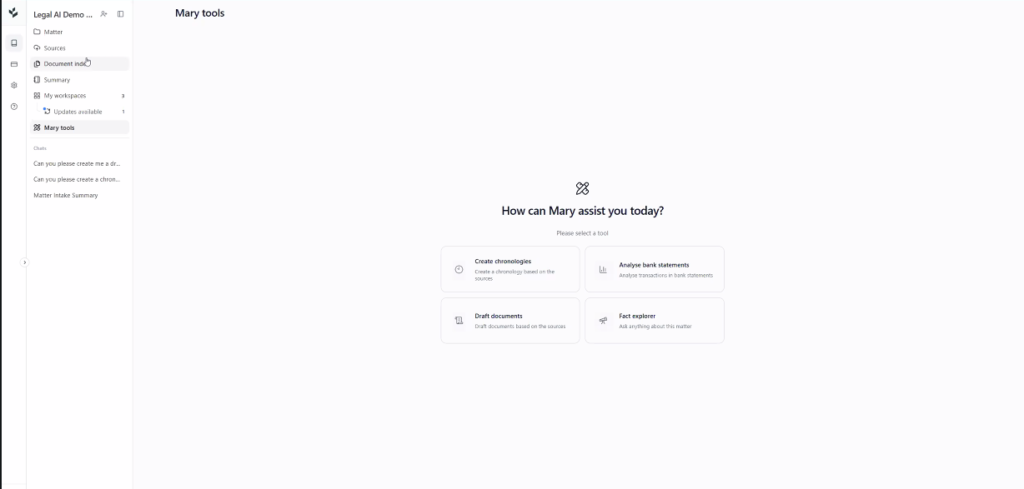
That specialization becomes clear at first glance. Instead of trying to cover every part of a law firm workflow, Mary concentrates its tools around four specific tasks: exploring the facts in a case file, building timelines, analyzing bank statements, and generating documents.
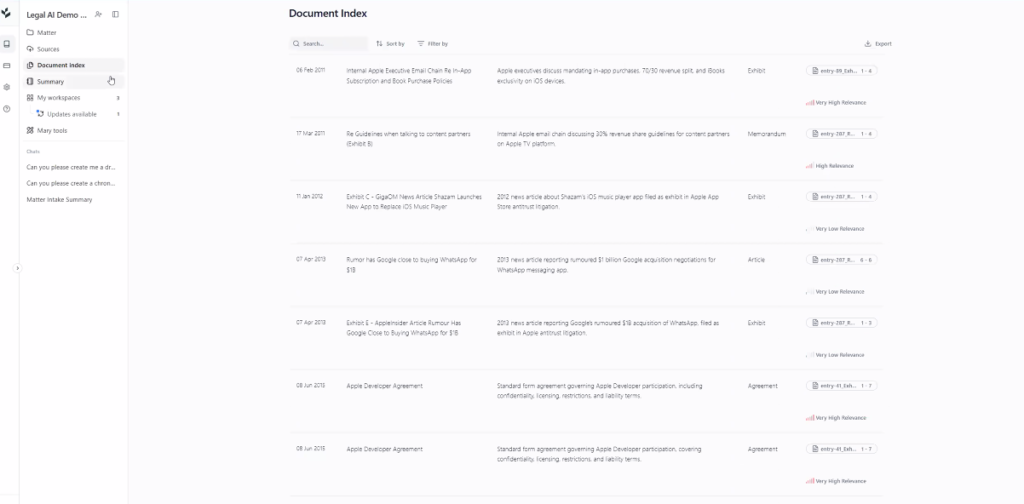
Once the documents are inside the matter, Mary turns them into an index you can work from. Instead of reopening files one by one, the attorney can navigate the documents, see what each one is about, identify its type, and quickly locate relevant sources.
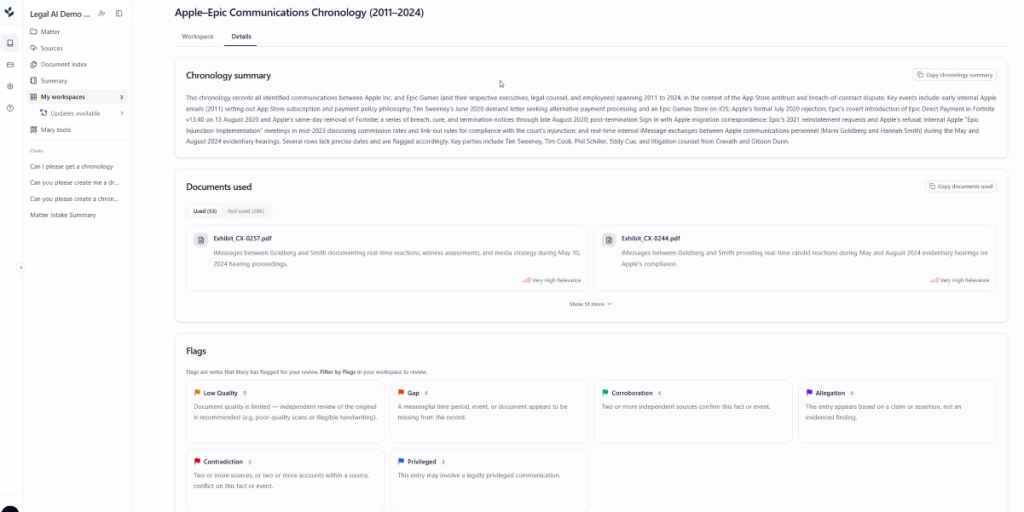
From there, Mary lets you work with the information in the case file using natural language and build timelines based on the available documents. In our demonstration, it took communications between Apple and Epic and built a timeline with more than one hundred entries, identifying dates, participants, types of communication, and summaries.
The most interesting part comes when you move from the timeline to quality control. Mary identifies potential gaps, contradictions, document quality issues, allegations, and corroborated facts, and allows you to review the sources used for each entry. The timeline stops being simply a list of dates and becomes a tool for assessing how solid the record actually is.
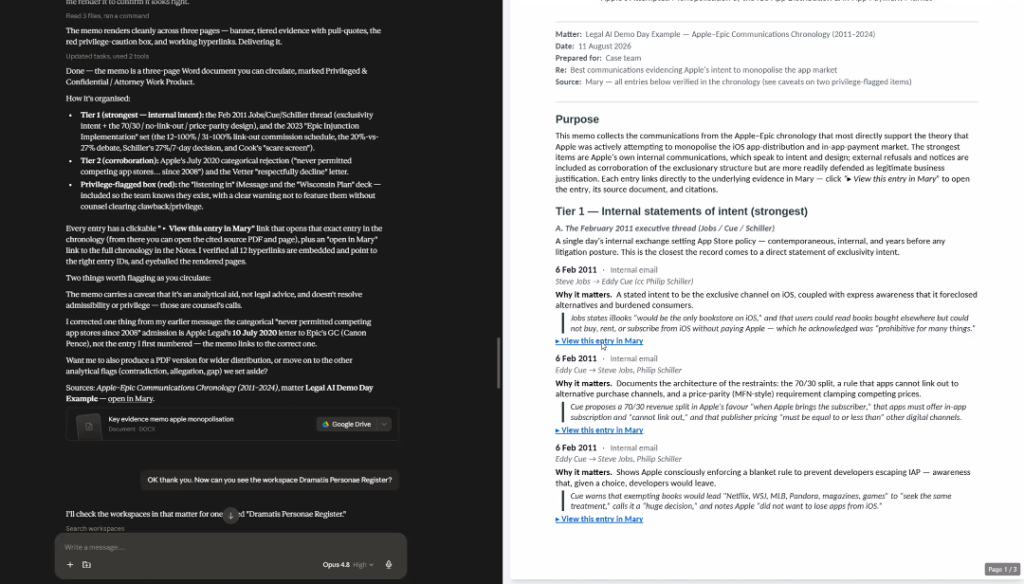
And that is where the system connects back to real legal work. Mary can turn that structured record into work product, such as a memorandum, while maintaining the links to the facts and sources supporting the analysis. In the demonstration, the generated memorandum included links that allowed you to go directly back to the corresponding entries within Mary and review the evidence behind each point.
After seeing the product in action, it becomes clear that Mary is not trying to replace every tool an attorney uses during a matter. Its proposition is much more specific: turning a difficult to navigate case file into a record of facts that can be explored, verified, and transformed into legal work. That decision to stay focused may be precisely what makes the tool useful when the problem is not knowing what to do with a case, but finding and proving exactly where each fact supporting it comes from.
Cost
Mary does not publish pricing. The model is consumption based, based on the volume of pages processed, with no long term contracts or minimum commitments. For US law firms, the platform currently offers 100 free page credits to test it with their own documents. One hundred pages will not cover an entire medical record, but they are enough to run the test that actually matters: upload a difficult set of documents and see how well Mary extracts, organizes, and traces the facts. The final cost will depend on the volume of pages your firm processes.
Why It Works
Most legal AI tools process documents to find relevant passages. Mary takes a different approach: it extracts individual facts and keeps them linked to the person involved, the issue, potential conflicts, and most importantly, the exact page they came from. That traceability is not a feature added to the result. It is the structure the product is built on. In litigation, where a small detail can change the meaning of a fact, knowing where an assertion came from can be just as important as the assertion itself. When you ask Mary how it reached a conclusion, you do not get another paragraph of AI. You get the page that supports it.
Privacy & Confidentiality
Mary’s documentation is fairly clear about how it protects client information. The platform uses language models through Microsoft Azure in an isolated instance architecture, encrypts information throughout its lifecycle, and states that customer data is not used to train or develop models without express consent. It also conducts annual penetration testing and maintains a public trust center. For a US law firm, however, there is one question worth clarifying before uploading confidential documents: the published privacy policy is governed by Australian law and the Australian Privacy Principles. That makes it particularly important to confirm in writing where client information actually resides and which rules apply to that data.
Verdict
If your practice depends on working with large volumes of documents, particularly in personal injury, family law, or litigation, Mary Technology is worth testing with its 100 free page credits. It is not an all in one legal AI platform and does not attempt to replace your legal research, drafting, or practice management tools. That is also its strength. Mary is built around a very specific problem: turning large, disorganized case files into a record of facts that you can trace and use. Most legal AI tools try to convince you they can think like a lawyer. Mary takes a narrower approach: making sure you can always find the fact you need and the page it came from.
Have Feedback?
I’ve reserved a special space each week for you to vent, supplement with relevant info, or ask questions about the product. The only way the content gets better is if you participate. I look forward to hearing from you! You can e-mail me here.