You ask a legal research question in an AI tool and, a few seconds later, an impressive answer appears. The writing is persuasive, the citations look correct, and the reasoning inspires confidence. The real question comes afterward. Is it based on the right jurisdiction? Do the cited authorities actually support the conclusions? Would you cite that answer with the same confidence as a case you researched yourself?
Most legal AI tools simply give you an answer. Evatt AI starts by showing you what that answer is built on. The platform draws from more than 45 million cases and statutes across six common law jurisdictions, reflecting a simple but important idea: in legal research, the quality of an answer depends not only on the model, but also on the legal foundation behind it.
Favorite Law Firm Use Cases: Legal research across common law jurisdictions, first drafts of contracts and demand letters, and rapid review of client documents.
Inside the Product
Evatt AI is built around three core functions: legal research, drafting, and document review. It does not try to become a case management platform or a law firm management system. The experience is much more straightforward. You open the platform, ask a question, and receive an answer supported by legal authorities. For many lawyers, that simplicity may be its greatest strength.
To test it, we started with a question whose answer would be easy to verify. We asked Evatt AI to summarize the elements of negligent misrepresentation under California law and organize them into a table, including a brief explanation of each element and the leading case supporting it. Within seconds, the platform returned a well organized response accompanied by a clear table and citations for each of the five required elements.
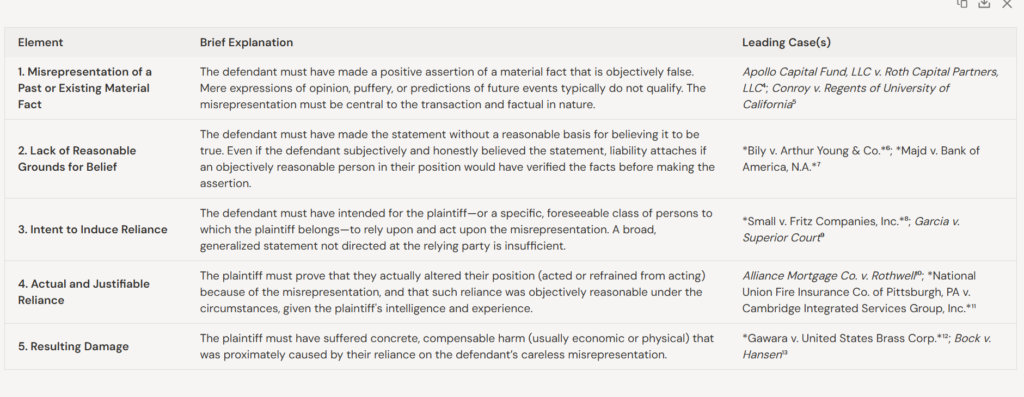
What stood out was not simply that the answer was correct. It was how easy it was to verify where every conclusion came from. In legal research, the value of an answer is not determined only by how convincing it sounds, but by whether the lawyer can review the authorities supporting it. That was an encouraging first indication of how Evatt AI approaches one of the most important questions in legal AI: not just what the answer is, but what it is built on.
Our second test was to ask Evatt AI to draft a confidentiality agreement for a software consulting company. With a single prompt, it produced a complete first draft organized into clauses and ready for editing. It did not simply generate a generic agreement. It also explained the legal reasoning behind several provisions and cited the statutes and cases supporting them, making the output useful not only for drafting but also for understanding why the document was structured that way.
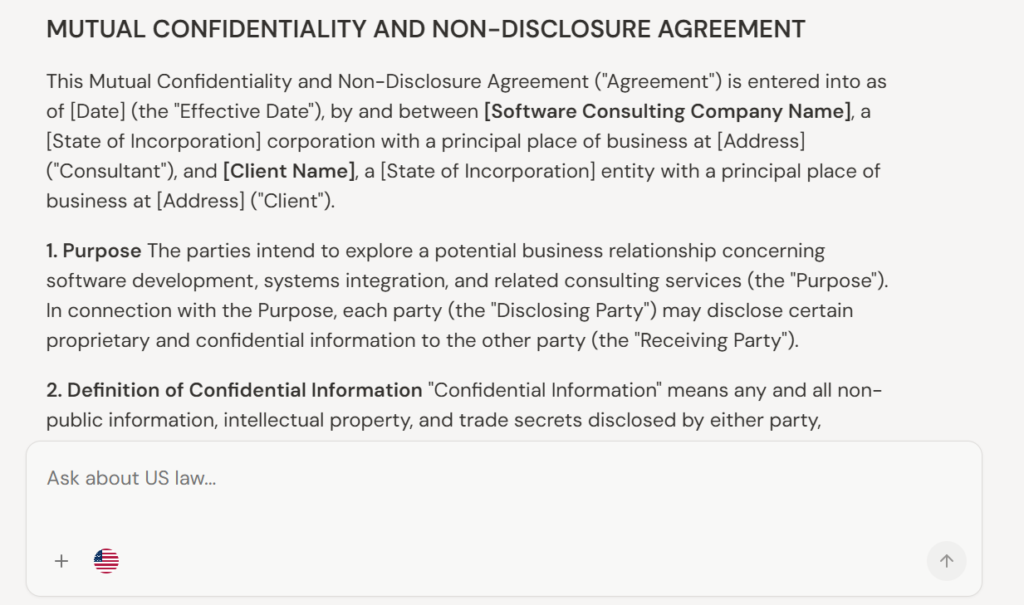
For the third test, we uploaded that same confidentiality agreement and asked Evatt AI to summarize its key obligations and identify any unusual provisions. Instead of merely describing the document, it analyzed the agreement from a legal perspective. It summarized the principal obligations and highlighted several drafting decisions that could create legal risks, explaining why they deserved attention and supporting its observations with applicable statutes and case law.
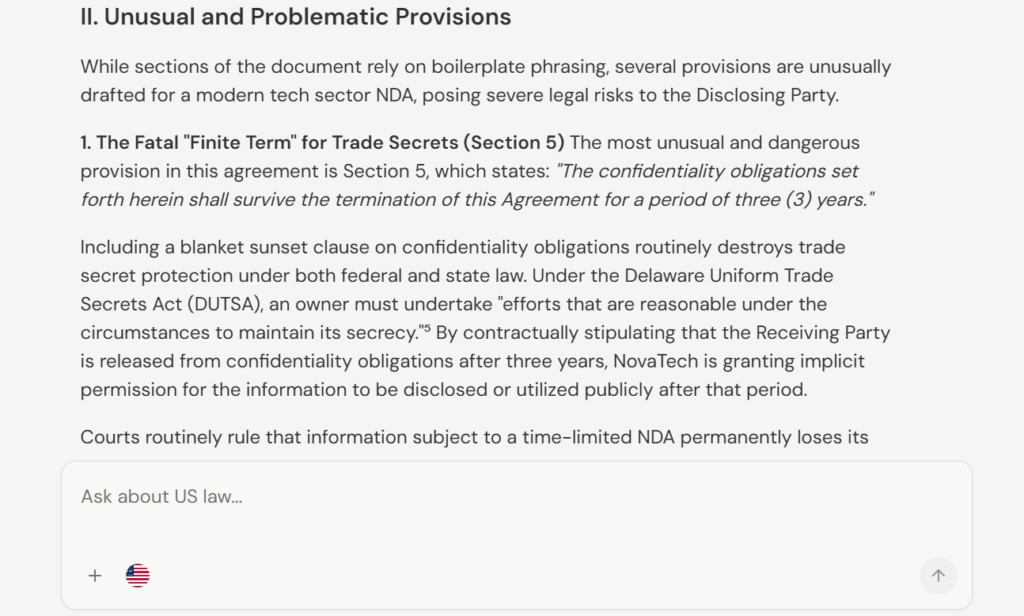
After using all three functions, Evatt AI feels less like a platform packed with dozens of unrelated tools and more like a legal assistant designed to answer legal questions with context and verifiable authority. Its greatest strength is not simply generating answers or documents. It is showing the legal sources and reasoning behind them. In a category where the real challenge is not getting an answer but deciding whether to trust it, that difference matters more than it first appears.
Cost
Evatt AI offers a free plan that lets you test the platform with 15 prompts before requiring a subscription. That is enough to run the most important test of all: ask a question whose answer you already know and see whether the research holds up. The only paid plan costs $159 per month and includes advanced legal research, contract drafting, document review, access to 45 million cases and statutes, and coverage across six common law jurisdictions. Although the plan is called Enterprise, it functions as an individual subscription with no long term contracts and no minimum license requirements.
Why It Works
Evatt AI’s biggest strength is that it treats jurisdiction as part of the answer rather than an afterthought. From the beginning, it makes clear which legal systems it covers, allowing lawyers to decide whether the platform truly fits their practice. That transparency, combined with natural language research, a genuinely free trial, and accessible pricing, makes Evatt AI easy to evaluate before deciding whether it deserves a place in your workflow.
Privacy & Confidentiality
Evatt AI states that it uses encryption technology to protect user information and preserve attorney client privilege. However, its public documentation does not explain with the same level of detail what happens to the documents lawyers upload, how long they are retained, whether they may be used to improve the models, or how they are deleted. That does not necessarily indicate a problem, but it does leave important questions for any firm handling confidential client information. Before incorporating the platform into your practice, those questions are worth discussing directly with the vendor.
Verdict
For a U.S. lawyer, Evatt AI would probably not be the first legal AI platform to choose for a practice focused exclusively on U.S. law. Not because the product is weak, but because it was built primarily for another jurisdiction and still leaves important questions about the handling of confidential information. Beyond Evatt AI, however, it offers a valuable reminder for anyone evaluating legal AI tools: before trusting an answer, ask what legal foundation it is built on. That question may be far more important than any feature list.
Have Feedback?
I’ve reserved a special space each week for you to vent, supplement with relevant info, or ask questions about the product. The only way the content gets better is if you participate. I look forward to hearing from you! You can e-mail me here.