Every lawyer knows the feeling. Throughout the day, the same matter moves from your research platform to the brief you’re drafting, to the assistant summarizing a deposition, to the document management system where your files live. Every time, you start over. Every time, you have to rebuild the context of the matter. The legal work isn’t the problem. The problem is that none of those tools share context. Irys was built to solve exactly that. Developed by a former litigator and a team made up entirely of lawyers, it brings research, drafting, and documents together around the same matter so the context doesn’t disappear every time you switch tasks.
Favorite Law Firm Use Cases: Drafting and reviewing documents with track changes, verifying citations, comparing document versions, and conducting research that stays anchored to the matter instead of getting lost across different tools.
Inside the Product
The first thing to understand about Irys is that everything revolves around a matter. A matter is much more than a folder for storing documents. It’s the workspace that powers the entire platform. You upload your files once, and from that point on, research, drafting, document comparison, and the AI assistant all work from the same set of facts. You don’t have to upload documents every time you switch tasks and, more importantly, you don’t have to rebuild the context in every tool you use.
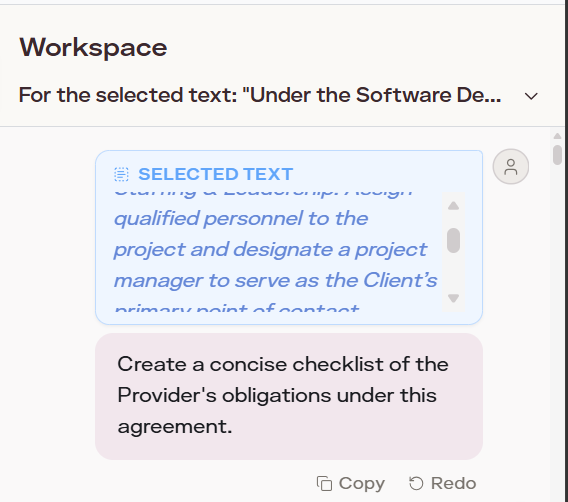
That shared context becomes apparent from the very first task. To test it, we uploaded a fictional services agreement and asked Irys to create a checklist of the provider’s obligations. Instead of simply answering in the chat, it generated an editable document directly inside the Workspace that could be reviewed and refined further. It may seem like a small detail, but it says a lot about how the platform is designed. The AI doesn’t just answer questions. It creates work product that becomes part of the matter itself.
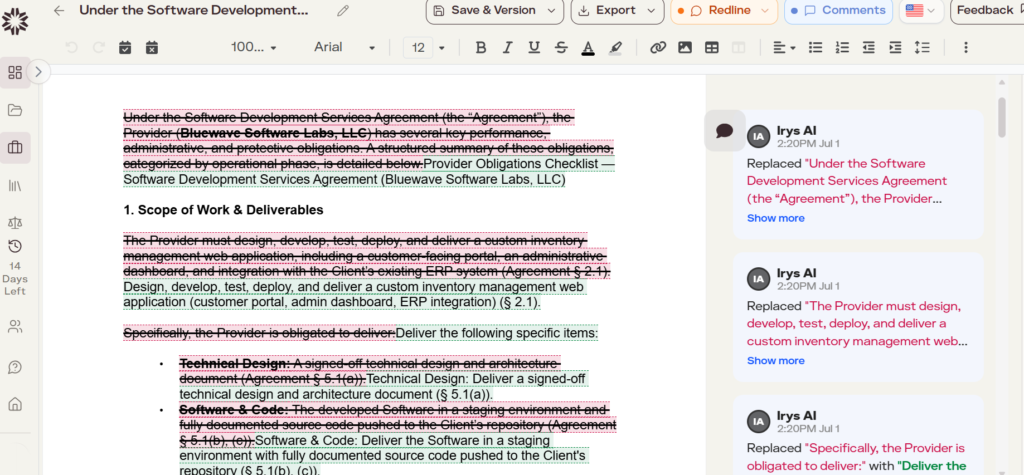
That same document can continue to evolve with the help of AI. Every edit appears as tracked changes. Deleted text is struck through, additions are highlighted, and nothing becomes final until you accept it. For lawyers who have learned the hard way not to let software rewrite their work without notice, this feature inspires a great deal of confidence. You don’t just see the final result. You see exactly what changed before deciding whether to keep it.
Research follows the same philosophy. Irys works with federal and state case law drawn from primary public sources through CourtListener rather than the proprietary editorial databases maintained by Westlaw or Lexis. That distinction matters because you’re working directly with judicial opinions, not editorial summaries or proprietary citators.
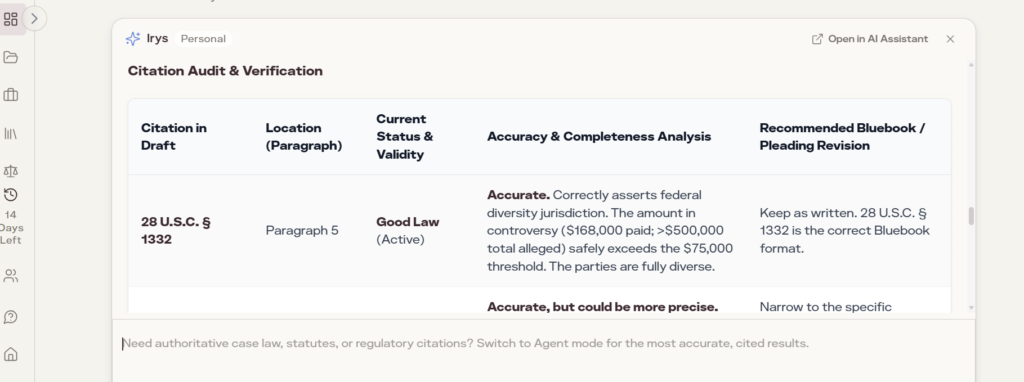
To test citation verification, we uploaded a fictional complaint and asked Irys to review every legal citation contained in the filing. The platform generated a table showing each citation and its verification status, making it easy to identify which citations are complete, which require attention, and which can be relied upon with greater confidence. It’s a straightforward feature, but it addresses one of the biggest concerns lawyers have about using AI today: whether citations can actually withstand independent review.
After spending some time working in Irys, you stop thinking about each individual feature. What becomes noticeable is that everything stays connected around the same matter. It’s the kind of advantage that’s difficult to appreciate from a feature list but becomes obvious after spending several hours working on a real case.
Cost
Irys One costs $299 per month for a solo attorney and includes access to every feature on the platform, with unlimited matters, documents, and AI conversations. Unlike many enterprise-focused legal AI platforms, it doesn’t require minimum seat commitments or long-term contracts, making it a far more accessible option for solo practitioners and small law firms. It also offers a two-week free trial with no credit card required, giving attorneys plenty of time to evaluate it using a real matter before making a decision.
Why It Works
The value of Irys isn’t found in any single feature. It’s that everything happens around the same matter. When research, drafting, and documents all share context, lawyers stop wasting time rebuilding the facts every time they switch tasks and can focus on what actually creates value: legal judgment.
Privacy & Confidentiality
Irys operates under a zero data retention model, meaning information submitted during a session is not stored afterward and is not used to train artificial intelligence models. For attorneys concerned about confidentiality, privilege, and protecting sensitive client information, this is likely one of the platform’s most important features.
Verdict
If you’re a solo attorney or part of a small law firm that’s pieced together multiple tools that never quite work together, Irys deserves a serious look. Its greatest strength isn’t any single feature. It’s the way it keeps your entire workflow connected around the same matter. The best way to evaluate it is also the simplest: upload a real matter and work the way you normally would. If, by the end of the day, you realize you never had to rebuild the context of the matter when switching tools, you’ll understand exactly why Irys is different.
Have Feedback?
I’ve reserved a special space each week for you to vent, supplement with relevant info, or ask questions about the product. The only way the content gets better is if you participate. I look forward to hearing from you! You can e-mail me here.