Every lawyer knows the scenario: a motion is due first thing Monday morning, the legal argument is largely complete, yet hours disappear into research, citation checking, formatting, and refining draft after draft. The legal analysis isn’t the bottleneck—the work surrounding the work is. Talden was built to address exactly that problem. Created by a practicing attorney, Talden conducts legal research, verifies citations, and generates editable drafts while adhering to the standards attorneys expect from their own work product.
Favorite Law Firm Use Cases: Drafting motions, reviewing contracts, preparing research memos, and stress-testing legal positions before negotiations or litigation.
Inside the Product
Talden operates the way a lawyer thinks. You give it instructions the same way you would a co-counsel. Describe the case, jurisdiction, legal context, and desired work product. From there, it generates jurisdiction-aware legal analysis and drafts tailored to the specific facts and circumstances you provide.
There is no meaningful learning curve and no complicated prompt engineering to wrestle with. You sit down, describe the situation in plain language, and within minutes you have a functional draft to react to instead of a blank page.
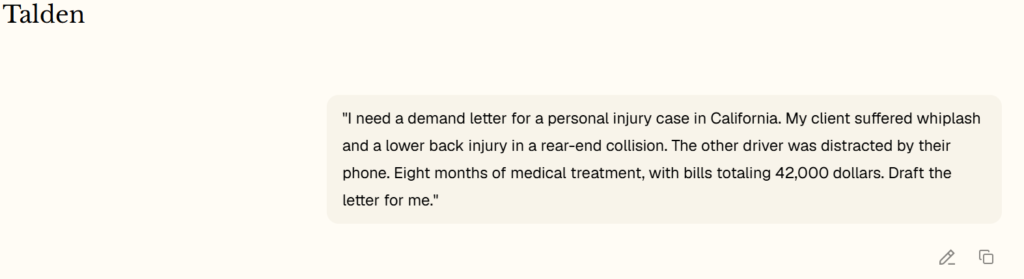
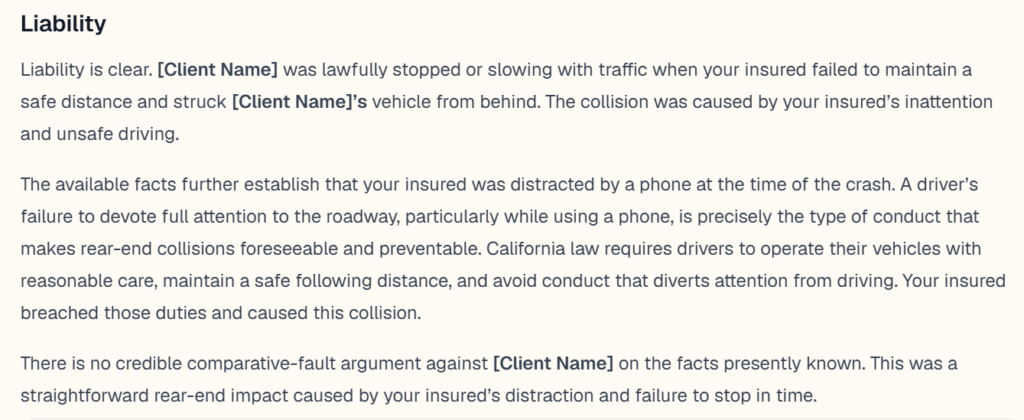
To see it in practice, consider a real-world example. With only four lines describing a California personal injury matter involving a rear-end collision, a distracted driver using a cellphone, eight months of medical treatment, and $42,000 in medical bills, Talden generated a complete demand letter. Not a template filled with placeholders, but a structured document containing liability analysis, damages, injuries, and a formal demand tailored to the specified jurisdiction.
The best way to understand Talden is to watch it work. Below, you can see the exact prompt it received and the legal reasoning it used to generate its response.
Once the initial draft exists, the iteration cycle is where much of the value appears. Talden reads your documents and anchors its work to them, meaning citations, references, and arguments remain tied to the underlying source material rather than floating in abstraction. If a clause is missing important contractual context, you’ll see it. If a brief relies on weak authority, you’ll see that too. The lawyer in you can focus on legal judgment rather than spending hours verifying every citation.
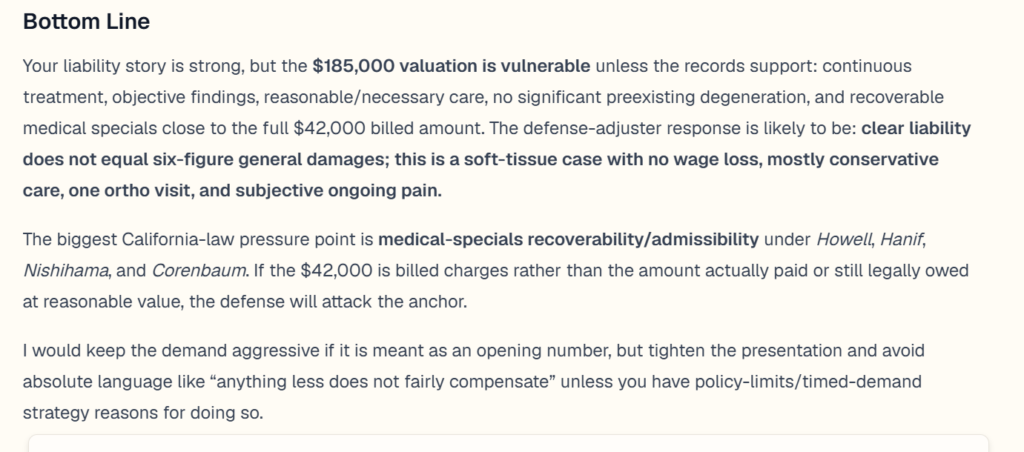
What separates Talden from a generic chatbot is its ability to challenge your own reasoning before opposing counsel does. You can provide a position you plan to take in a brief or negotiation and ask it to identify weaknesses, counterarguments, and contrary authority. For a personal injury attorney preparing a demand letter, that means entering negotiations knowing where the adjuster is likely to push back. For a transactional attorney reviewing an agreement, it means identifying clauses that appear reasonable on the surface while quietly shifting risk to the client.
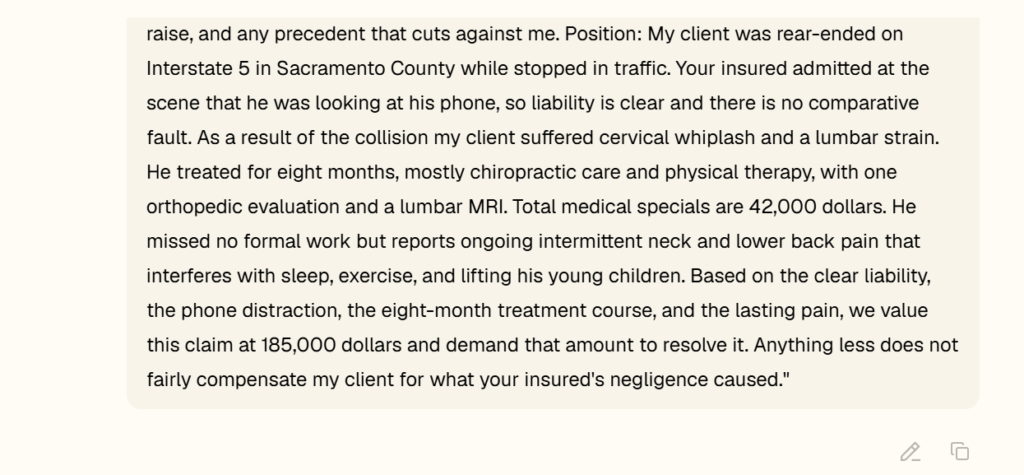
To see this in action, we gave Talden the position an attorney intended to take with an insurance adjuster in the same personal injury matter and asked it to attack the argument. Within seconds, it identified weaknesses in the proposed valuation, anticipated likely counterarguments, and highlighted relevant California case law that could be used against the attorney’s position.
Below, you’ll see the position that was provided and the analysis Talden returned.
In practice, Talden occupies a space where many other legal technology products struggle. Enterprise platforms often require contracts, implementation processes, and minimum seat commitments. Generic AI tools are inexpensive, but they were never designed for serious legal work. Talden sits between those two categories, offering self-service onboarding, no minimum license requirements, and an experience built specifically for lawyers from day one.
Cost
Talden costs $200 per month and includes unlimited legal research, drafting, review, and iteration. Unlike many enterprise legal platforms, it does not require long-term contracts or minimum seat commitments, making it particularly attractive for solo practitioners and small law firms. The platform also offers a two-week free trial so attorneys can evaluate it using real matters before making a decision.
Why It Works
Talden uses advanced language models to analyze documents, connect facts to relevant authority, and generate drafts supported by verifiable sources. Its greatest advantage is not producing text faster. It is reducing the time required to reach a trustworthy first draft, allowing attorneys to spend more time on strategy, negotiation, and client service.
Privacy & Confidentiality
Talden operates under a zero data retention model, meaning information submitted during a session is not stored afterward and is not used to train artificial intelligence models. For attorneys concerned about confidentiality, privilege, and the protection of sensitive client information, this is one of the platform’s most important features.
Verdict
If you’ve been waiting for legal AI to mature before allowing it anywhere near real legal work, Talden is one of the most compelling options I’ve tested recently. Built by a practicing attorney for the work lawyers actually do, it combines research, drafting, and review into a single platform without the barriers typically associated with enterprise software. At $200 per month and with a two-week free trial, the best way to evaluate it is simple: run it against a real matter and determine whether the output holds up to the same standard you demand from your own work.
Have Feedback?
I’ve reserved a special space each week for you to vent, supplement with relevant info, or ask questions about the product. The only way the content gets better is if you participate. I look forward to hearing from you! You can e-mail me here.