After our first LLM review, I decided it was time to review the LLM that started it all, ChatGPT by OpenAI. Prior to ChatGPT, like most attorneys, I would wade through volumes of precedent in order to make those small changes to contracts that invariably come up. Often I realized something frustrating: I was rewriting the same indemnification clause for the fifth time, searching for the perfect balance between aggressive protection and negotiable language. My mind was exhausted, but the deadline wouldn’t wait. That’s when I decided to ask ChatGPT: “Give me three versions of this indemnification clause, each with a different level of protective aggression.” Within 30 seconds, I had drafted options that were well-reasoned and ready to adapt. It didn’t replace my legal judgment, but it multiplied my capacity to explore alternatives without sacrificing hours of sleep. From that day forward, ChatGPT became an indispensable tool—not as a replacement for the mind of an attorney, but as the tireless assistant every legal professional deserves.
Favorite law firm use cases: Drafting contract clauses, NDAs, and legal memos with contextual precision; accelerating case law research and generating precedent summaries in seconds; preparing deposition questions and trial strategies by simulating opposing counsel arguments.
Features & Functionality
ChatGPT isn’t just a sleek chatbot—it’s a conversational platform powered by generative A.I. that functions as a versatile legal assistant available anytime. Unlike specialized tools that do only one thing, ChatGPT is an extraordinarily capable generalist: it can draft, review, research, summarize, translate, and reason through complex legal problems, all within a simple chat interface. All you need to do is frame your request clearly, and the A.I. responds with grounded, nuanced answers adaptable to your specific context.
Imagine this scenario: you’re preparing a motion to dismiss and need to quickly identify the most relevant precedents in your jurisdiction on a technical issue of product liability. Instead of spending two hours navigating Westlaw with imperfect search terms, you ask ChatGPT: “What are the key Ninth Circuit cases on the application of the unavoidable risk doctrine in product defect lawsuits since 2015?” The A.I. returns a structured summary with case names, relevant citations, and the core judicial reasoning from each. Then you can dig deeper: “Now give me a comparative analysis of how these cases treat the burden of proof for the defendant.” ChatGPT delivers a preliminary memo you can refine, verify in legal databases, and adapt to your strategy. It doesn’t eliminate your research work, but it gives you a solid starting point in minutes instead of hours.
ChatGPT’s versatility also shines in contract drafting. Suppose your client needs a bilateral confidentiality agreement with specific clauses about intellectual property derived from a biotechnology collaboration. You can ask ChatGPT: “Draft an NDA clause covering confidential information in a joint biomedical research project, including protections for clinical data, trial results, and ownership of derivative inventions.” Within seconds, you receive a well-structured clause that includes precise definitions, party obligations, standard exceptions, and language on IP ownership. Then you can iterate: “Make it more restrictive for the receiving party” or “Add a provision for return of materials upon termination of the agreement.” Each adjustment takes seconds, and the result is a professional draft you can polish with your client-specific expertise.
One of the most powerful uses is litigation preparation. When you’re facing complex testimony or need to anticipate opposing counsel’s questions in a deposition, ChatGPT can act as your intellectual sparring partner. I tested this by asking ChatGPT to act as opposing counsel in a construction contract breach case where my client—a contractor—failed to complete a residential remodel on time, causing $50,000 in damages.
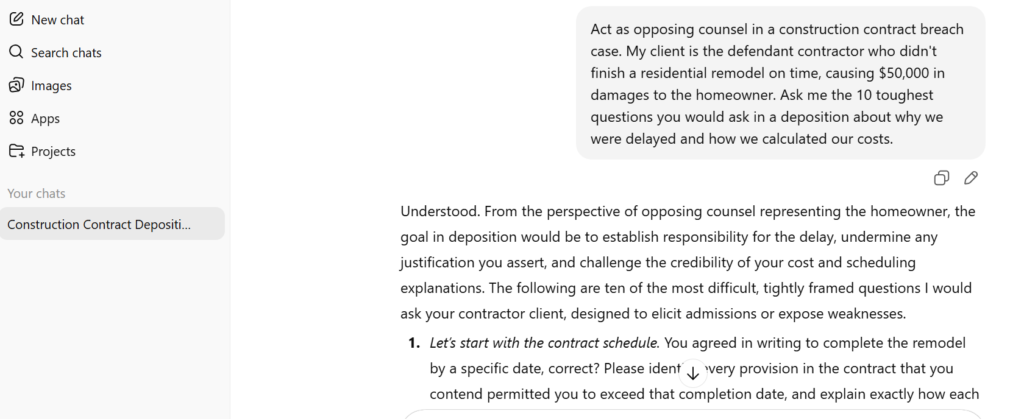
Within seconds, ChatGPT generated ten tightly framed, aggressive questions designed to establish responsibility for the delay, undermine justifications, and challenge the credibility of cost calculations. As you can see in this screenshot, the questions aren’t generic—they demand specifics about contract provisions, site inspections, week-by-week delay causation, written notices, and subcontractor selection. This is the type of incisive cross-examination you’d expect from an experienced litigator trying to box you into admissions or expose weaknesses in your record.
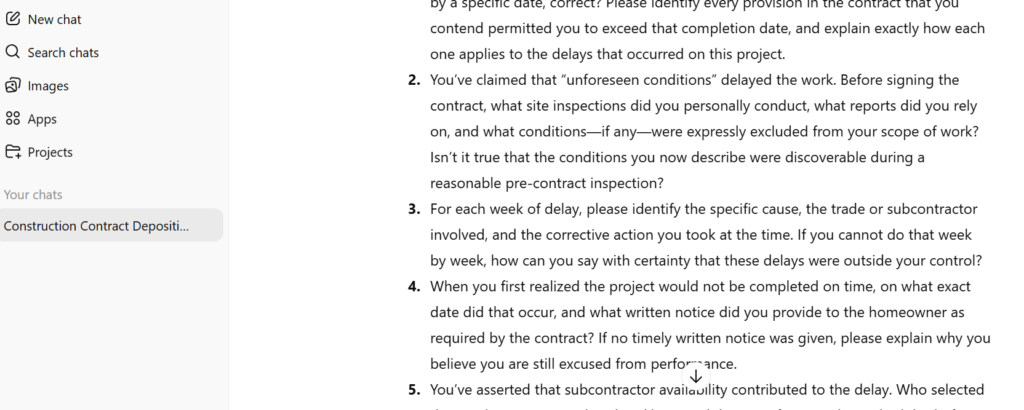
But ChatGPT doesn’t stop at playing the adversary. In the follow-up, I asked ChatGPT to help me prepare strong, defensible answers to the toughest questions.
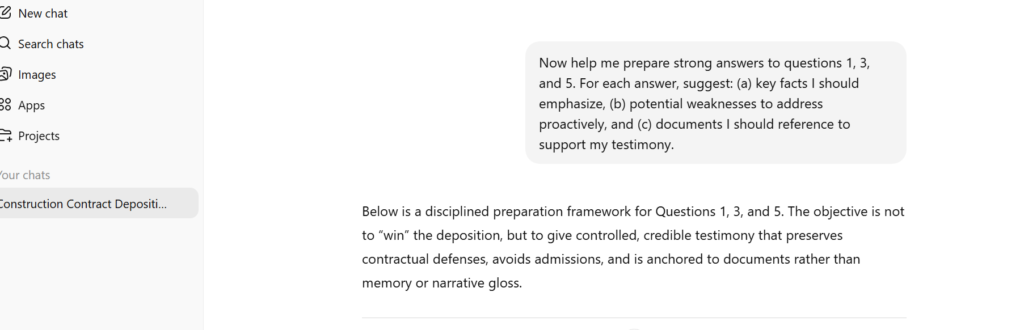
The A.I. immediately switched roles and provided a disciplined preparation framework for each question. For Question 1 about contractual basis for extending the completion date, ChatGPT identified key facts to emphasize—such as the contract conditioning the schedule on specified contingencies—and suggested specific provisions to reference that allowed time extensions for owner-requested changes, concealed conditions, and delays outside the contractor’s control. The response wasn’t just theoretical; it gave me concrete talking points anchored to documents and contract language.
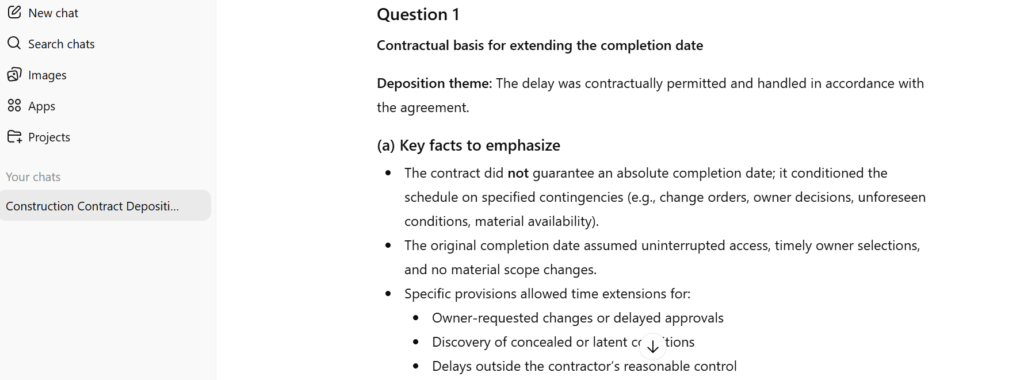
The same strategic depth applied to Question 3 about week-by-week causation of delays. ChatGPT reframed the narrative around identifiable events rather than general mismanagement, emphasized that work was resequenced to mitigate impacts, and pointed to the logical sequence of residential remodeling standards as evidence of good-faith project execution. For each answer, ChatGPT also flagged potential weaknesses to address proactively and identified specific documents—like change orders, owner correspondence, and inspection reports—that would support credible testimony.
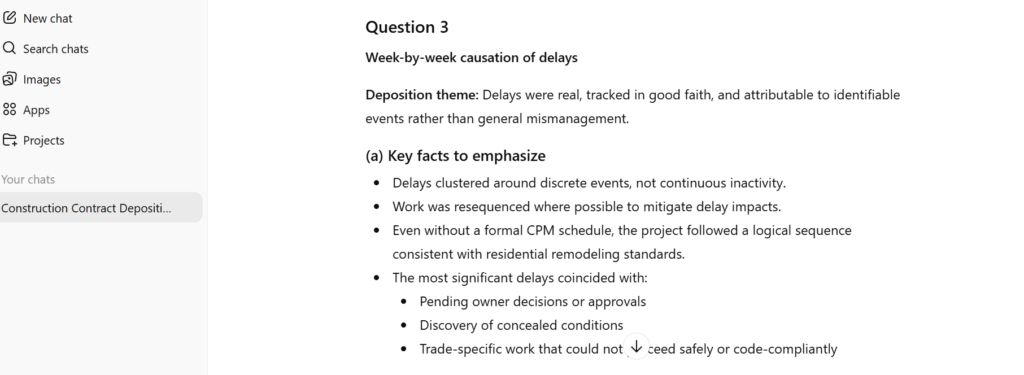
This is what makes ChatGPT invaluable for deposition prep: it doesn’t just attack your case from every angle—it then helps you build an airtight defense, all without coordinating schedules, billing hours, or waiting for a senior partner’s availability. It’s like having a litigation strategist available 24/7 who can simulate opposing counsel, then immediately pivot to coaching you on how to respond with confidence and credibility.
Now, I know what you might be thinking. What about the dreaded hallucinations? Yes, indeed they happen. This is why I always tell practitioners that you must treat these LLMs like a law clerk and be sure to double check the output. Too many lawyers are taking the outputs at their word. I like to think of it this way: an LLM can get you 80% of the way there, but you still need to use your skills as a lawyer to ensure accuracy.
Pricing & Plans
ChatGPT offers an accessible and scalable pricing model. The free version gives you access to GPT-4o mini, which is surprisingly capable for everyday tasks. However, for attorneys, if you are working on client work product, you MUST choose a paid option so that you can toggle off the sharing of data with the large lanugage model. Don’t allow your data to be used to train the model. For professional legal use, the ChatGPT Plus plan at $20 USD per month is the recommended option, giving you access to GPT-4o, the most advanced model with deeper reasoning and more precise responses. If your hourly rate is $250 USD and ChatGPT saves you just three hours per month on drafting and research tasks, you’ll have recovered your entire annual investment ($240 USD) in that first month. Most attorneys report savings of 5 to 10 hours per week, translating into tens of thousands of dollars in recovered billable time or redirected toward higher-value strategic work.
What Makes It A.I. Enabled?
ChatGPT is built on GPT-4, one of the world’s most advanced large language models (LLM), developed by OpenAI. It uses transformer architecture and deep learning to process and generate natural language with a level of coherence, context, and reasoning that mimics human thought. Unlike traditional rule-based chatbots, ChatGPT employs advanced natural language processing (NLP) and machine learning to understand the intent behind your questions, not just the keywords. What makes ChatGPT A.I.-enabled isn’t just its ability to generate text, but its capacity to reason about complex problems, adapt to specific contexts, and maintain the context of an entire conversation, enabling iterative and refined dialogue that transforms the tool from a simple search into an intelligent assistant.
Security & Privacy
Security and privacy are legitimate concerns for any attorney. OpenAI has implemented multiple layers of protection: data is encrypted in transit and at rest using TLS, complies with enterprise security standards and regulations such as GDPR and CCPA. Regarding model training, in the free and standard Plus versions, OpenAI may use data to improve its models, though it offers options to disable this in privacy settings, only with paid versions. For professional legal use, OpenAI offers ChatGPT Enterprise and enterprise API, where it contractually guarantees that your data is not used for training and that you have complete control over data retention and deletion. ChatGPT can be secure for legal use if you choose the right plan and configure privacy settings appropriately to protect attorney-client privilege.
The Judgment
ChatGPT isn’t a passing fad or a tech toy—it’s a transformative tool that’s redefining how attorneys research, draft, and reason in their daily practice. It offers a cost-benefit ratio that’s hard to match: for $20 per month, you gain access to an A.I. capable of saving you hours each week, improving the quality of your drafts, and amplifying your capacity to explore complex legal strategies. It doesn’t replace your experience, judgment, or professional responsibility, but it does multiply your efficiency and free up your time for the strategic work that truly matters. If you haven’t yet integrated ChatGPT into your practice, you’re leaving money, time, and competitive advantage on the table. My verdict: it’s an essential investment for any attorney who wants to stay relevant, productive, and competitive in the A.I. legal era. Try it this month, and I’ll bet that in 30 days you won’t be able to imagine your practice without it.
Have Feedback?
I’ve reserved a special space each week for you to vent, supplement with relevant info, or ask questions about the product. The only way the content gets better is if you participate. I look forward to hearing from you! You can e-mail me here.