
Ever wished you could go to Google or Bing (j/k who uses Bing? 😂), type in a question in the search bar and get an answer back that aggregates the best information out there with a citation back to the websites it came from? Sure, ChatGPT or Claude can give you an answer, but you don’t always know where it comes from. And if you are a lawyer, you probably have “cite your source” on repeat in your head. Enter Perplexity—an AI search tool that’s on a mission to make knowledge accessible and concise, all while saving you from the deep rabbit holes of endless web page searches. It’s your streamlined guide through the information labyrinth, though with some quirks that might leave you, well, a bit perplexed.
Favorite law firm use cases: Easier web searching for summaries of knowledge with citations to sources for easy access to the most helpful websites.
Features & Functionality
Perplexity operates as a web-based AI search and answer tool, bringing an innovative twist to conversational research. Think of it as an amalgamation of Google, a trusted assistant, and that friend who always has a “Did you know?” fact at the ready. The platform shines when asked to retrieve bite-sized summaries or simple explanations of legal topics. Whether you’re double-checking a statutory definition or looking for background information on your client, Perplexity’s AI delivers concise answers backed by citations.
Here’s where it gets even more exciting: imagine if ChatGPT could pull answers from Reddit and link you directly to social conversations from X (formerly known as Twitter). That’s the experience Perplexity offers. It feels like a more connected, informed version of ChatGPT, with one significant difference—an internet lifeline that provides real-time, source-linked information. This is where web search is moving (Google has integrated an AI Overview on a limited number of searches). So, when you’re digging into research that benefits from seeing user discussions or current updates, Perplexity delivers the goods, and you can click through to read full threads for additional context. This capability is perfect for gaining insights quickly, especially on contemporary or evolving topics where up-to-date information is crucial.
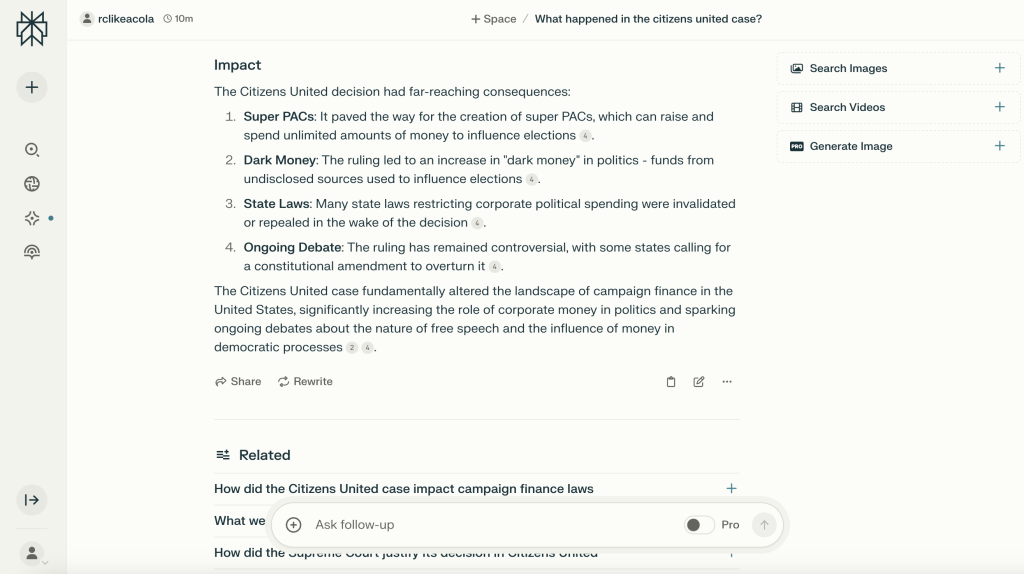
Since you are seeing this on Election Day (or a week after on LinkedIn – maybe we’ll have a President Elect within 7 days? 🤷♂️), I thought I would do a search that is election related. I used a sample search of: “What happened in the Citizens United case?” Simple enough. To show you how great Perplexity is, I did the search in Google. See what I got back:
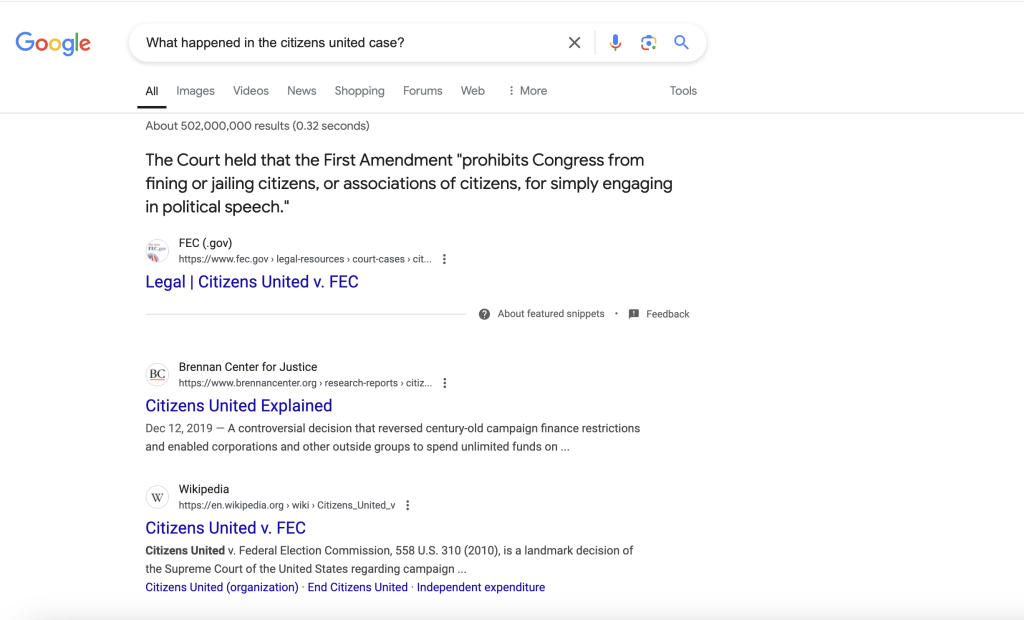
Not bad, but not really helpful. Like most searches, you still have to rifle through web pages to get a good summary. On the other hand, here is what Perplexity yielded:
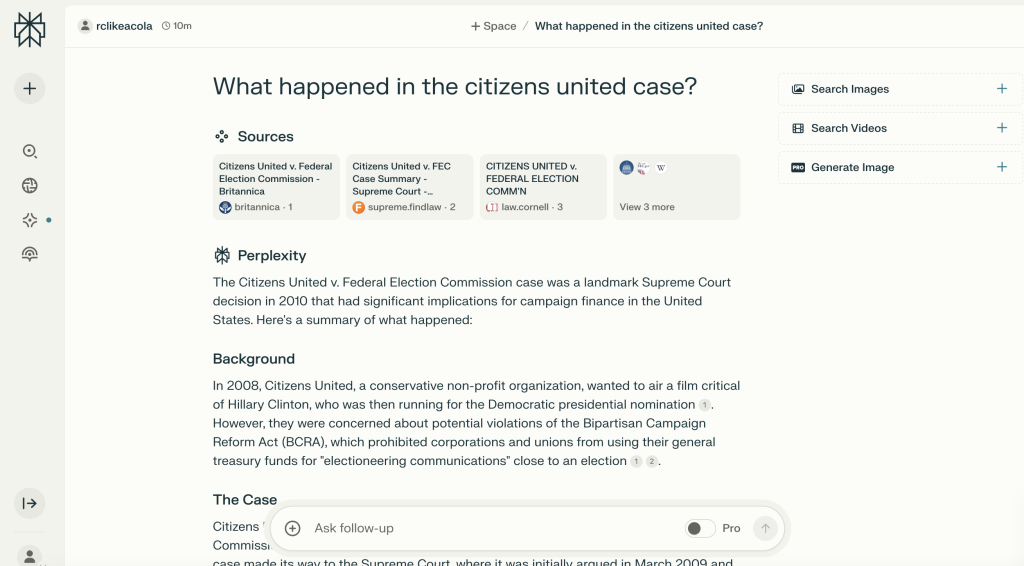
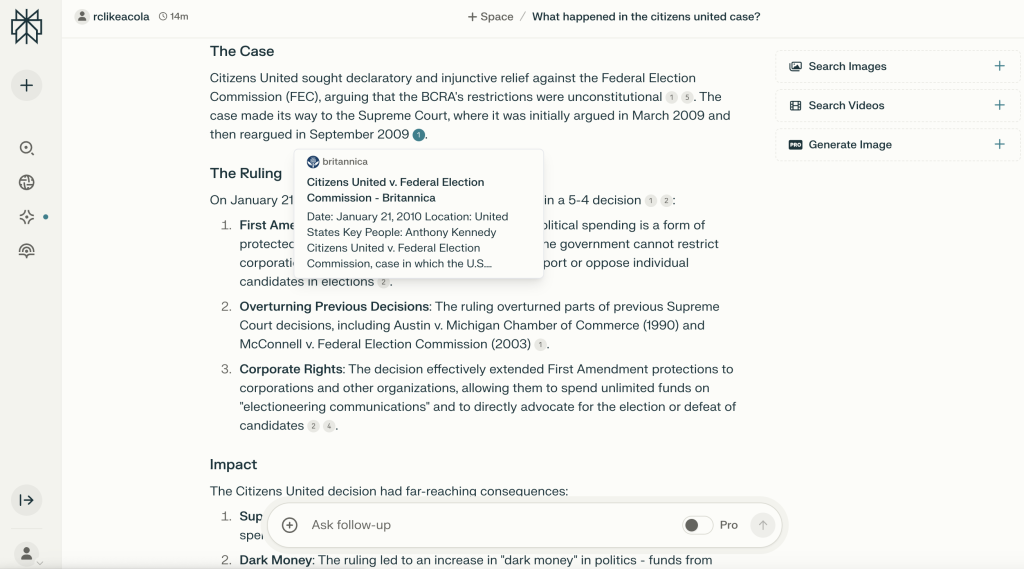
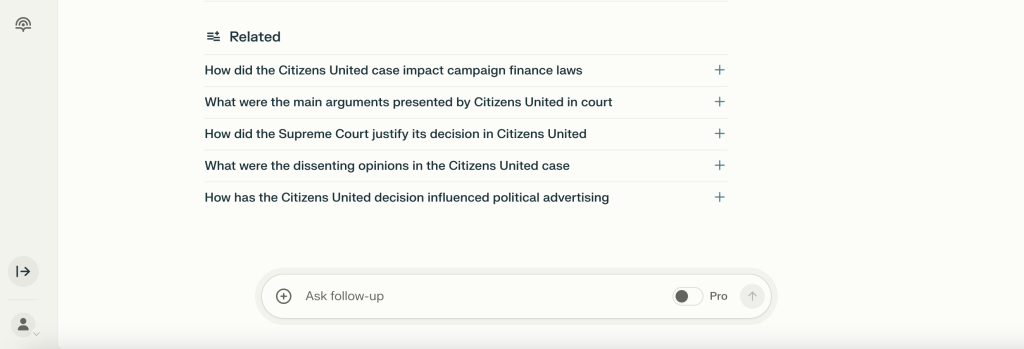
Imagine no more toggling between dozens of tabs or slogging through dense texts. You query, and Perplexity serves up a clean, reference-laden response. Want to go deeper? You can click the embedded links to see the source material—a true blessing when you’re trying to ensure the AI didn’t just make it all up. Here we see a Background, the Case Summary, a Ruling and Impact. And at the bottom you see a Related section that prompts follow up questions.
For high-level understanding and context, Perplexity functions as an agile knowledge aide. Its integration with browser extensions makes it even more versatile, allowing seamless searches directly from your favorite web pages—ideal for attorneys needing quick answers during a research sprint. But remember, it won’t draft your motion for summary judgment or provide exhaustive case analysis. It’s best used as a companion for initial research inquiries (legal or otherwise), sparking ideas, or summarizing complex concepts. Ask a “How To” question with the comfort of linking to source material for veracity.
Perplexity can be downloaded as an app on iPhone and Android. This is great for easy access on your mobile device. Perplexity has been slowly replacing my standard Google searches.
And I highly recommend you test Perplexity with yourself. What do I mean by that? Type in a search for “Who is ?” I would venture a guess that for most of you with a web presence the result will be pretty precise, citing to websites. I was surprised at how well Perplexity summarized me. I did the same search in Google and Google’s AI summary told me I was in a role from 2017, so Perplexity clearly performed better for me. This can be a very helpful tool for gathering some intelligence on opposing parties in an adversarial proceeding.
Overall, Perplexity is a compelling AI tool that merges the conversational abilities of modern chatbots with the source-reliability of search engines, making it a practical assistant for lawyers in need of fast, accurate information at their fingertips.
Pricing & Plans
Here’s the GREAT news: Perplexity is FREE. No, that’s not a typo. The company has chosen a community-driven approach, making the tool widely accessible. For lawyers and firms (or anyone) wanting a peek into AI research tools without breaking the budget, this is a major plus. There’s talk of future paid features or a more robust professional version, but for now, the only cost is your time to get there.
What Makes It A.I. Enabled?
Perplexity utilizes a combination of sophisticated large language models (LLMs) to power its natural language processing capabilities12. These include: GPT-4; Claude 3; Mistral Large; and Perplexity’s own custom models. These LLMs enable Perplexity to understand the context and nuances of user queries, ensuring it can interpret questions accurately and provide relevant responses. Unlike traditional chatbots, Perplexity performs real-time searches of the internet to gather up-to-date information. This allows it to provide current and relevant answers, even for rapidly changing topics or live events. And Perplexity doesn’t just return search results; it compiles and summarizes information from multiple authoritative sources to create coherent, easy-to-understand answers. This synthesis of information sets it apart from traditional search engines.
Security & Privacy
Now, the nitty-gritty: Can you trust Perplexity with sensitive client matters? Short answer: Be cautious. Perplexity’s primary goal isn’t law firm-level security. Although it doesn’t use your searches to train its models, the tool does collect and store query data, and there’s no ironclad confidentiality promise akin to legal research titans like Lexis or Westlaw. The AI does well enough to protect your everyday curiosities, but it’s not a place to type out a client’s full name and case strategy just to be safe. For now, I’d suggest treating Perplexity like a public library—great for research, but not a place to whisper your client’s secrets.
The Judgement
Perplexity isn’t trying to be the most exhaustive legal research tool—it’s aiming to be the most convenient web search tool. For lawyers craving instant knowledge boosts or practice area overviews, this tool delivers in spades. But it comes with a caveat: it’s no replacement for comprehensive legal research, and caution is advised when using it for anything involving client confidentiality. As a free tool, it’s perfect for quick lookups, sparking research ideas, or helping with non-sensitive educational inquiries. Think of Perplexity as your AI sidekick for moments when speed and simplicity are paramount. It’s handy, efficient, and surprisingly wise for its age.
I have to caveat this review with the fact that ChatGPT just announced they have a web search tool they released to a limited crowd of paid users and it will likely compete very well with Perplexity. But a lot of people know of ChatGPT and I love to surface products that are a little less known.
Feedback
I’ve reserved a special space each week for you to vent, supplement with relevant info, or ask questions about the product. The only way the content gets better is if you participate. I look forward to hearing from you! You can e-mail me at rc@sabersolutions.co.