In the bustling intersection of legal tech and generative A.I., a new contender is making an argument for your attention. Enter Draftme, a platform positioning itself as the next-generation drafting assistant for legal professionals, promising to cut hours from your document creation workload while keeping your language polished and, crucially, compliant. But as any litigator will tell you, a strong opening argument doesn’t win the case—execution does. So, does Draftme deliver more than a shiny user interface and catchy promises? Let’s examine the evidence.
Favorite law firm use cases: creating transactional templates on demand, updating boilerplate clauses with fresh language, and offering on-the-fly suggestions for clarity, tone, and risk mitigation.
Features & Functionality
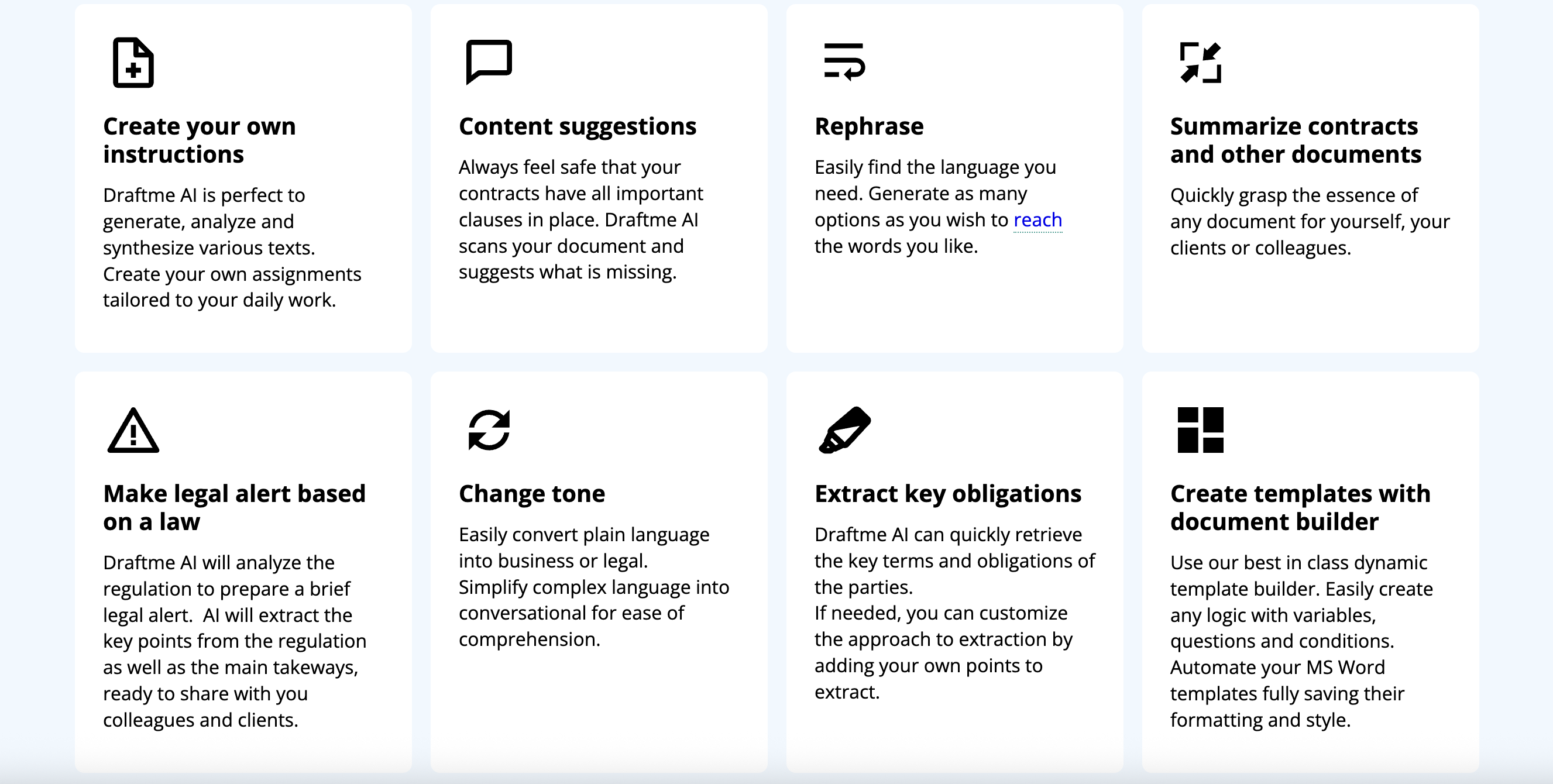
Draftme’s value proposition shines brightest when dissected through the lens of real-world law firm workflows, where efficiency battles nuance, and the perfect clause is worth its weight in billable hours. The platform greets users with a crisp, no-nonsense dashboard that eschews clutter in favor of action. From the first click, it’s clear this tool was designed for the legal mind: focused, structured, and always within reach of precedent. Creating an account is easy, and once logged in you are presented with with several options from document generation through translation and grammatical support.
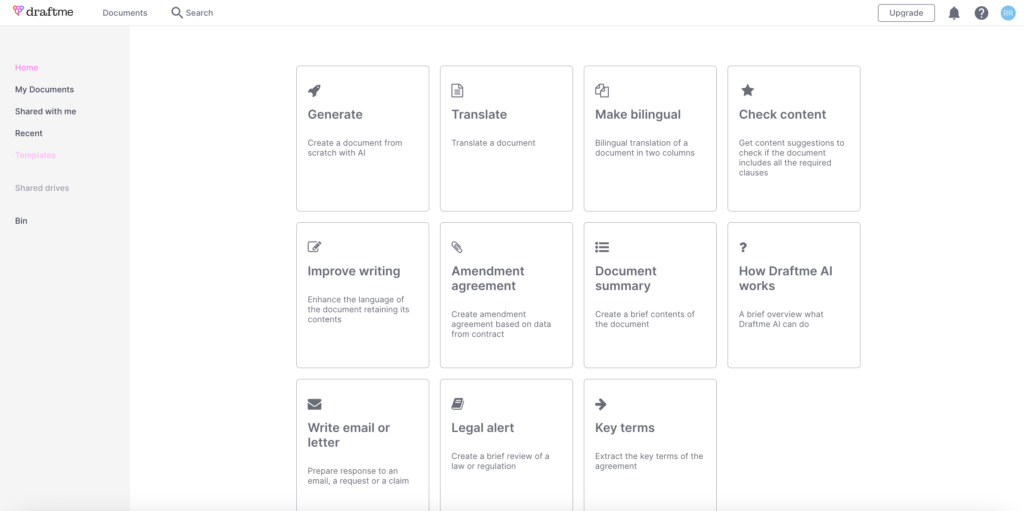
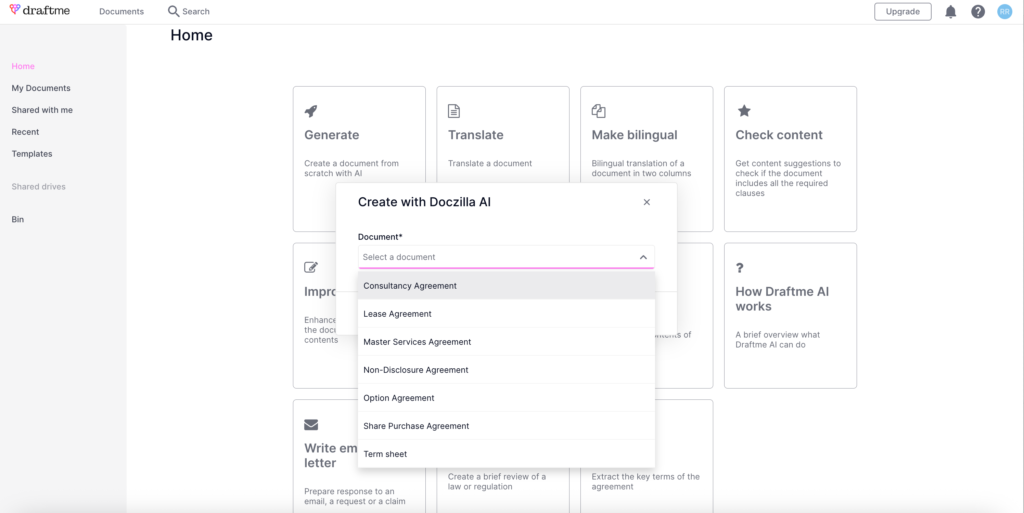
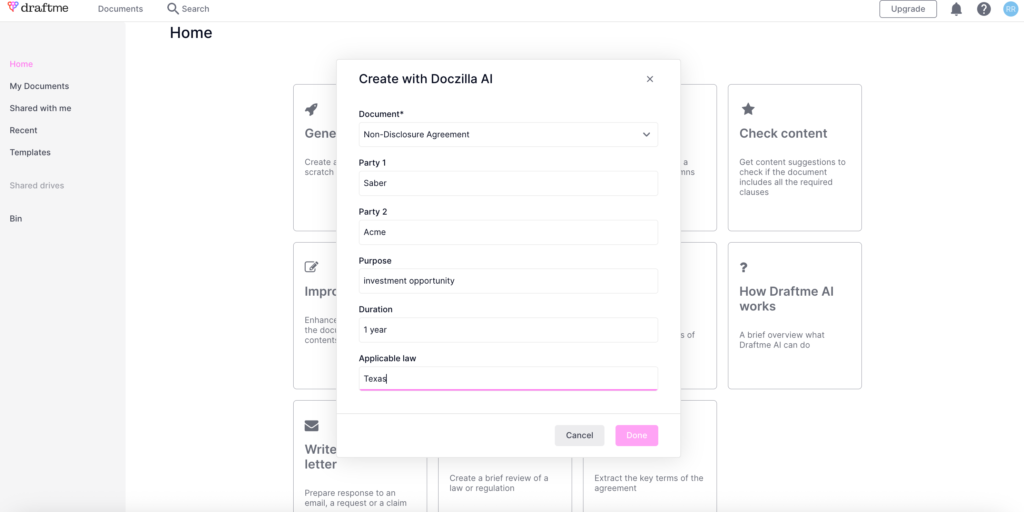
The document generation module is the heart of Draftme. Users input basic deal parameters—such as party names, contract type, governing jurisdiction, and deal specifics—through a simple form. From there, the A.I. assembles a draft that doesn’t just tick legal boxes but is also easy to understand. In testing, even complex documents like Share Purchase Agreements emerged from Draftme’s engine with a well-formed structure, integrated fallback clauses, and suggested optional provisions for higher-risk scenarios.
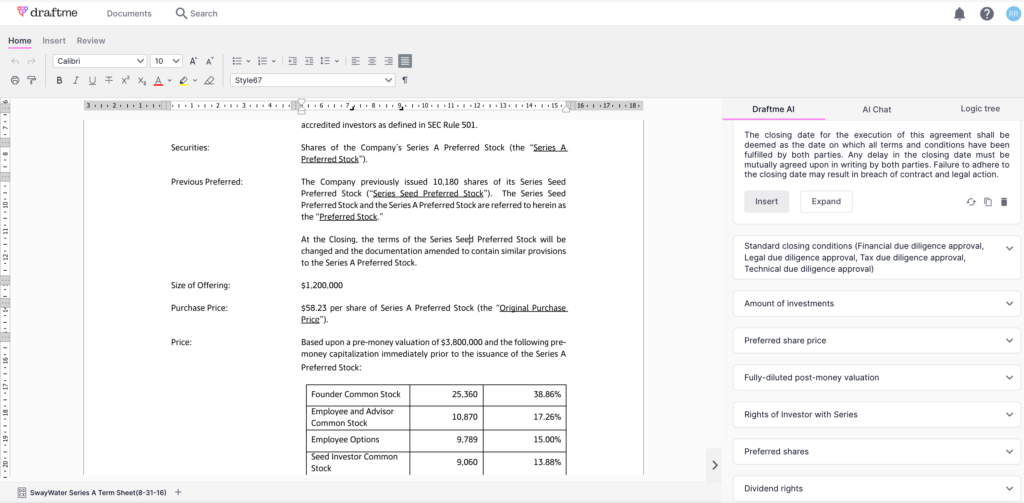
Equally powerful is the Check Content feature, arguably Draftme’s sleeper hit. You can upload any document, select language within the document you want to check, and Draftme will review the content and suggest changes if appropriate. This ensures every NDA, master service agreement, or licensing contract aligns with best practice language. This feature doesn’t limit itself to spelling and grammar either; instead, it dives into legal coherence, flagging ambiguous phrasing, passive voice, and even potential loopholes in liability clauses. The interface within the editor means inserting those clauses is as seamless as drafting in Word—only smarter.
Draftme has numerous other features. Chief among them are its easy-to-use templating tools, which along with its library of model clauses, enable users to automate repetitive drafting tasks. It also supports auto-building decision trees and progress tracking, which highlight missed fields and streamline document completion.
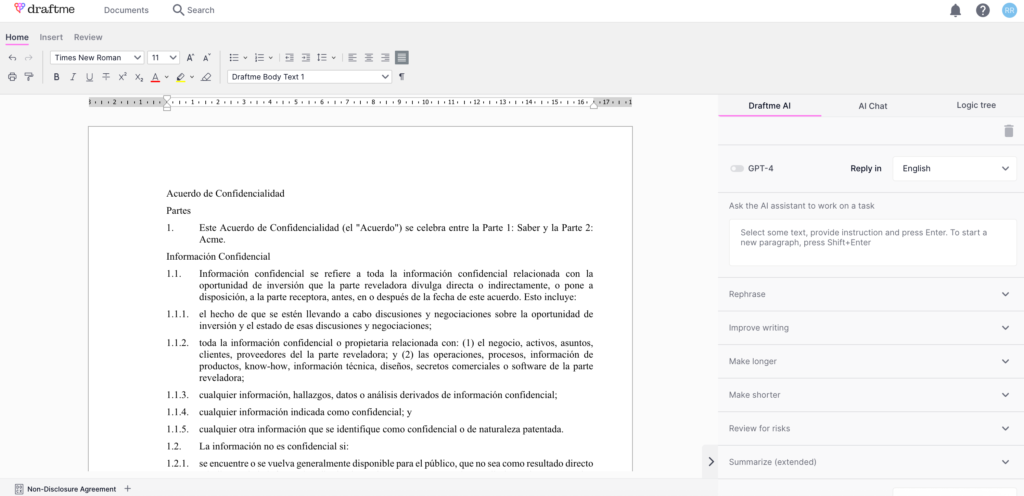
One of the features I found to be unique amongst the products I have reviewed is Draftme’s translation feature. It is a thoughtfully integrated tool designed to meet the unique demands of legal professionals working with multilingual documents. Unlike generic translation services, Draftme’s translation function is powered by advanced A.I. models that are specifically tuned for legal terminology. This means that when you translate a contract, agreement, or any other legal document, the system works to preserve not only the literal meaning but also the nuanced intent and legal precision that such documents require. For my use case, I had it translate my model NDA into Spanish and it performed quite well.
Draftme offers a strong feature set, but attorneys should temper expectations when it comes to hyper-nuanced or jurisdictionally exotic agreements. And note that the platform is currently geared toward business transactional document creation and drafting assistance. It offers an impressive starting point, even if some of tis suggestions can sometimes drift toward the generic, particularly in niche industries where boilerplate won’t suffice. Draftme operates not as an overconfident legal oracle, but as a meticulous first-pass scribe—accelerating your workflow while still keeping you firmly in the editor’s chair.
Pricing & Plans
Draftme offers a SaaS subscription model, with pricing tiers that scale based on user seats and document volume. The Personal plan is only $40/month and caters to solo practitioners and small firms, offering most all features, absent dynamic templates. You can add the dynamic templates feature by choosing the Business plan priced at $60/month which includes all the features of the Personal plan. The Enterprise plan courts large firms with multi-team access, API integrations, and dedicated customer support with custom pricing available. Best of all, you can try Draftme for free with a 7 day trial (always my favorite way to demo a product). More than enough time for you to give it a test drive.
What Makes It A.I. Enabled?
At its core, Draftme is powered by a fine-tuned large language model, trained specifically on legal drafting conventions and contract structures. Unlike generic generative AI tools, its algorithms are purpose-built for legal syntax, incorporating contextual awareness of jurisdictions, clause interdependencies, and tone calibration. The A.I. doesn’t merely generate text—it analyzes your inputs to produce legally coherent drafts, offering contextual clause recommendations, fallback positions, and risk flagging. Draftme supports both GPT-3.5 and GPT-4 models, enabling more advanced reasoning and nuanced text generation for complex legal tasks, especially on higher-tier plans.
Security & Privacy
For a tool elbowing its way into sensitive drafting workflows, data security isn’t optional—it’s existential. Draftme acknowledges this by offering end-to-end encryption, strict data residency options (including the ability to house data on firm servers or secure private clouds), and compliance with GDPR, CCPA, and other regulatory frameworks. The company asserts that client data is never used to train public models, and firms can request deletion of data upon termination of service.
The Judgement
Draftme earns points for ambition, usability, and addressing a real pain point for lawyers tired of staring at blank screens. Its clause library and adaptive drafting feel like the generative A.I. tools the legal industry has been cautiously waiting for—not overhyped robots claiming to replace lawyers, but pragmatic assistants ready to shoulder the first draft burden. It’s not yet a plug-and-play savior. Firms adopting Draftme should treat it as a junior associate who shows promise but still needs mentoring—reliable for first drafts, but not to be sent into court unsupervised. For law firms seeking to modernize their drafting processes without sacrificing precision, Draftme presents a compelling case. The verdict? Worth a trial—just don’t forget to review its work with a critical lawyer’s eye.
Feedback
I’ve reserved a special space each week for you to vent, supplement with relevant info, or ask questions about the product. The only way the content gets better is if you participate. I look forward to hearing from you! You can e-mail me here.