Every lawyer knows the feeling: a new case arrives and, with it, a mountain of documents — police reports, medical records, emails, witness statements, and invoices — that must be reviewed before a solid legal strategy can even begin. Reconstructing the sequence of events is often one of the slowest parts of case preparation, as attorneys and paralegals can spend hours reviewing files just to understand what happened and in what order. CaseMark approaches this problem from a different perspective: instead of organizing information manually, attorneys can upload case documents and allow the AI to analyze the materials, identify key events, and automatically generate a structured timeline of the facts.
Favorite law firm use cases: Automatically generate case timelines from medical records, accident reports, and witness statements; quickly review large volumes of discovery documents to identify key facts; and create clear case summaries to prepare for mediations, hearings, or client meetings.
Features & Functionality
CaseMark is designed around a workflow that reflects how attorneys actually review case materials. Instead of manually organizing documents or reviewing files one by one, lawyers can upload entire case folders into the platform. Once uploaded, the system analyzes the documents and identifies important dates, relevant events, and contextual references that help reconstruct the story of the case.
After uploading the documents, CaseMark allows users to apply different analysis functions. To test how it works in practice, I uploaded a relatively long deposition transcript into the matter and used the Summarize function. Within seconds, the platform analyzed the document and automatically generated a matter summary, identifying key elements of the case: the parties involved, the litigation context, the main issues in dispute, and the current procedural posture. This type of summary allows an attorney to quickly understand the structure of the case without having to read the entire transcript from start to finish.
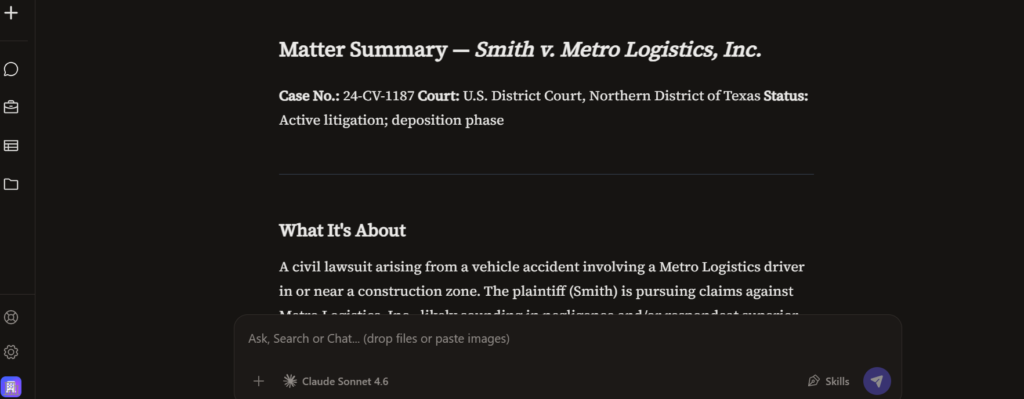
One of the most valuable features is the automatic generation of case timelines. CaseMark organizes extracted information into a clear chronological view, allowing attorneys to quickly understand how events unfolded. For litigation teams handling complex matters — especially those involving multiple documents and witnesses — this structure can provide immediate clarity.
In addition to organizing information chronologically, CaseMark also includes a series of specialized skills designed for different types of legal work. Within the platform, categories such as Agreement, Analysis, Checklist, Drafting, Litigation, Memo, Regulatory, Research, Summarization, Summary, and Transactional allow attorneys to apply different analytical approaches depending on the task they need to perform.
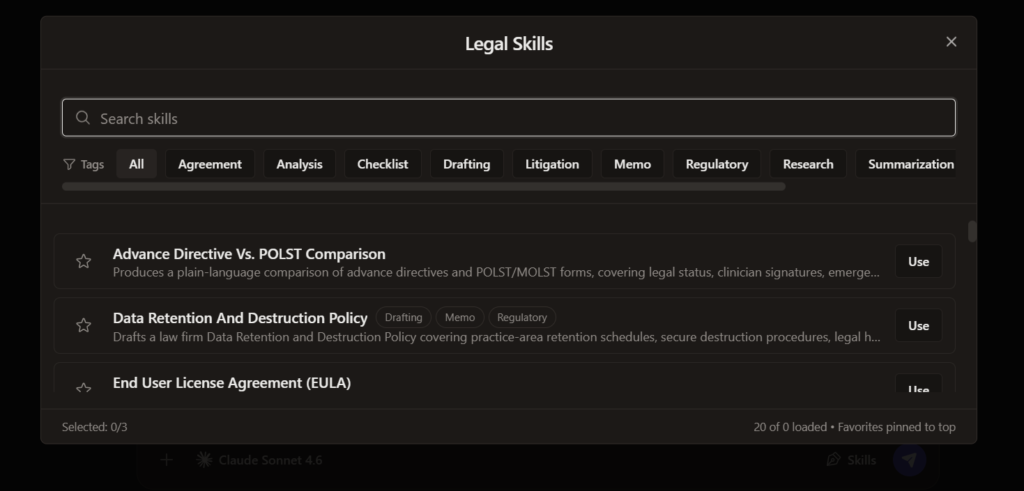
To test how it works in a litigation context, I selected the Litigation skill and used the following prompt: “Identify potential liability issues based on the deposition testimony.” Using the previously uploaded document, CaseMark analyzed the deposition transcript and generated an analysis focused on potential liability issues arising from the testimony. This type of functionality allows attorneys to quickly identify potential arguments, relevant facts, or key statements that could influence litigation strategy, without manually reviewing every section of the document.
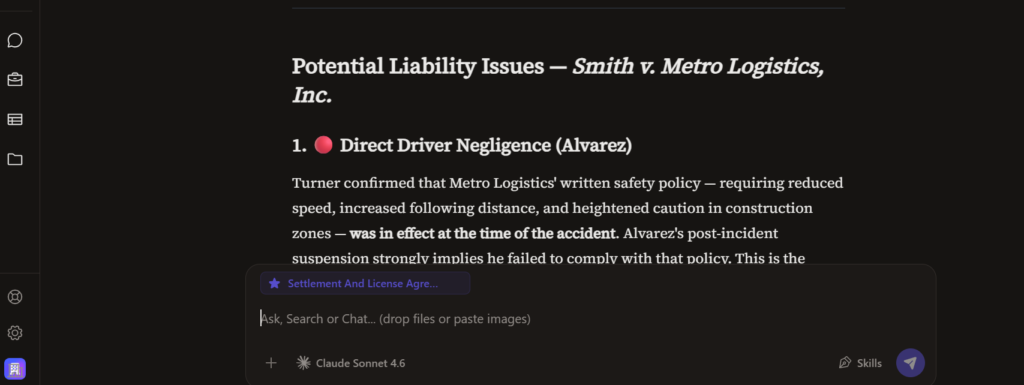
In addition to the initial matter summary, CaseMark allows users to continue exploring the case through additional queries based on the uploaded documents. This makes it possible to move quickly from a general overview of the case to a deeper analysis of the legal or regulatory context surrounding the facts.
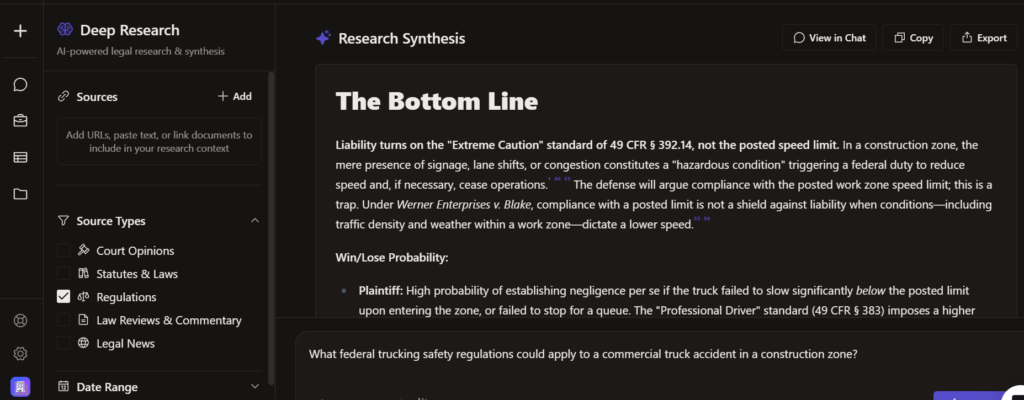
To further explore the legal context of the case, I also tested one of the platform’s research functions. I used the prompt: “What federal trucking safety regulations could apply to a commercial truck accident in a construction zone?” Based on the information contained in the deposition, CaseMark generated a detailed regulatory analysis connecting the facts of the case with federal regulations applicable to commercial transportation.
For example, the tool identified the “extreme caution” standard established in 49 CFR §392.14, a federal regulation requiring commercial vehicle drivers to reduce speed and exercise additional caution when hazardous conditions exist, such as congestion or lane changes within construction zones. The analysis also referenced relevant judicial decisions and evaluated how these regulations could influence liability arguments for both the plaintiff and the defense.
This type of analysis demonstrates how the platform not only reviews case documents but also helps connect the facts with the applicable regulatory framework and relevant case law, providing attorneys with a starting point for evaluating potential litigation strategies.
CaseMark integrates easily into a law firm’s daily workflow. Attorneys can use the platform during the initial case evaluation, while reviewing discovery materials, or when preparing arguments for a hearing or mediation. By automating document analysis, fact extraction, and quick access to regulatory context, the platform reduces the time spent on manual review and allows attorneys to focus on what matters most: legal analysis and case strategy.
Pricing & Plans
CaseMark uses a Pay-As-You-Go pricing model that allows users to begin with a free trial that includes one summary credit valid for 14 days and full access to the platform without requiring a credit card. Basic Summaries cost $25 per summary and include depositions in page-line or narrative format, summaries of hearings, trials, or arbitrations, and exhibit lists downloadable in PDF or Word. For more advanced analysis, Advanced Summaries start at $50 and include deposition analysis and detailed medical summaries — chronology, narrative, and analysis — at approximately $0.10 per page, along with fast OCR processing for scanned documents and HIPAA-compliant standards. The platform also offers OCR services starting at $1.00 per 1,000 pages processed (or $0.55 per 1,000 pages for volumes exceeding one million pages per month), with approximately 99.5% accuracy, advanced Bates numbering, and an API designed for enterprise integrations.
What Makes It A.I. Enabled?
CaseMark uses advanced AI technologies to analyze complex legal documents and extract structured information from large volumes of files. The platform employs natural language processing (NLP) to interpret document content and identify key entities such as dates, people, events, and relevant actions within the case file. Through machine learning models and large language models (LLMs), the system also detects relationships between events distributed across multiple documents, enabling it to reconstruct the case timeline automatically and generate clear summaries of the legal narrative. Rather than simply indexing documents, the AI processes information in a way similar to how an attorney would analyze a complete case file.
Security & Privacy
Data protection is a fundamental priority in legal technology tools like CaseMark, as attorneys work with highly confidential client information. Documents uploaded to the platform are typically protected through encryption both during transmission and at rest, while access control systems ensure that only authorized users within the firm can view or manage case files. Additionally, responsible legal technology providers generally clarify that documents uploaded by users remain private and are not used to train public AI models, helping preserve the confidentiality of client information.
The Judgment
Every litigation team eventually faces the same challenge: transforming scattered documents into a clear narrative explaining what happened and why it matters. CaseMark introduces AI directly into this process, turning large volumes of documents into structured timelines, summaries, and analysis that attorneys can use immediately. Instead of spending hours manually reconstructing the chronology of events, lawyers can focus on what truly matters — developing arguments, preparing strategy, and effectively representing their clients. For firms handling litigation matters with large volumes of documents, CaseMark offers a practical and efficient way to incorporate AI into everyday legal work.
Have Feedback?
I’ve reserved a special space each week for you to vent, supplement with relevant info, or ask questions about the product. The only way the content gets better is if you participate. I look forward to hearing from you! You can e-mail me here.